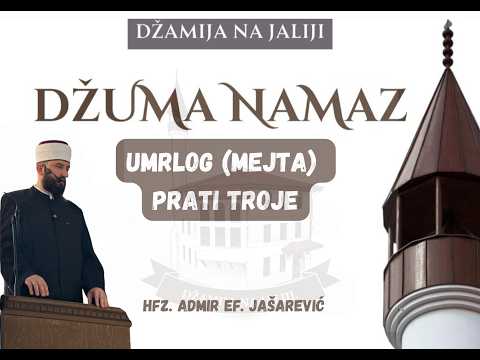
Umrlog (mejta) prati troje
Three Things Follow the Deceased (Mayyit)
Automatski transkript (lektorisan)Automatic transcript (proofread)
Automatski transkript. Napravljen je iz zvuka snimka i lektorisan, ali nije provjeren uz slušanje— moguće su greške, naročito u imenima i arapskim citatima. Mjerodavan je video.
Machine translation. Translated from the automatic Bosnian transcript — names and Arabic quotations may be inaccurate. The video is authoritative.
- 0:00
الْحَمْدُ لِلَّهِ نَحْمَدُهُ وَنَسْتَعِينُهُ وَنَسْتَغْفِرُهُ
Hvala pripada Allahu; Njega hvalimo, od Njega pomoć tražimo i od Njega oprost molimo.
- 0:40
وَنَعُوذُ بِاللَّهِ مِنْ شُرُورِ أَنْفُسِنَا وَمِنْ سَيِّئَاتِ أَعْمَالِنَا مَنْ يَهْدِهِ اللَّهُ فَلَا مُضِلَّ لَهُ، وَمَنْ يُضْلِلْ فَلَا هَادِيَ لَهُ
Utječemo se Allahu od zla naših duša i od naših loših djela. Koga Allah uputi, njega niko ne može zavesti, a koga On ostavi u zabludi, njega niko ne može uputiti.
- 0:52
وَأَشْهَدُ أَنْ لَا إِلَٰهَ إِلَّا اللَّهُ وَحْدَهُ لَا شَرِيكَ لَهُ وَأَشْهَدُ أَنَّ مُحَمَّدًا عَبْدُهُ وَرَسُولُهُ أَرْسَلَهُ اللَّهُ بِالْحَقِّ بَشِيرًا وَنَذِيرًا وَسِرَاجًا مُنِيرًا
Svjedočim da nema boga osim Allaha, Jedinog, Koji nema sudruga, i svjedočim da je Muhammed Njegov rob i poslanik. Allah ga je poslao s istinom kao donosioca radosnih vijesti, opominjača i svjetiljku koja sija.
- 1:06
لِيُنْذِرَ مَنْ كَانَ حَيًّا وَيَحِقَّ الْقَوْلُ عَلَى الْكَافِرِينَ صَلَّى اللَّهُ تَعَالَى عَلَيْهِ وَعَلَى آلِهِ الطَّيِّبِينَ الطَّاهِرِينَ وَأَصْحَابِهِ الْكِرَامِ الْهُدَاةِ الْمُهْتَدِينَ وَسَلَّمَ تَسْلِيمًا كَثِيرًا إِلَى يَوْمِ الدِّينِ
Da opominje one čija su srca živa i da se obistini Riječ protiv nevjernika (Ja-Sin, 70). Neka Uzvišeni Allah blagoslovi njega i njegovu dobru i čistu porodicu i njegove plemenite ashabe, upućene koji su i druge upućivali, i neka mu podari obilan selam do Sudnjeg dana.
- 1:24
قَالَ اللَّهُ فِي كِتَابِهِ الْكَرِيمِ يَا أَيُّهَا الَّذِينَ آمَنُوا اتَّقُوا اللَّهَ حَقَّ تُقَاتِهِ وَلَا تَمُوتُنَّ إِلَّا وَأَنْتُمْ مُسْلِمُونَ أَمَّا بَعْدُ
Allah kaže u Svojoj plemenitoj Knjizi: „O vjernici, bojte se Allaha onako kako Ga se treba bojati i ne umirite drugačije nego kao muslimani!“ (Ali Imran, 102). A zatim:
- 1:36
Zahvala pripada jedinom Uzvišenom Allahu, subhanehu ve te'ala, Gospodaru svjetova, Gospodaru Sudnjeg dana.
- 1:46
Neka je salavat i selam na Njegovog Poslanika, miljenika Muhammeda, sallallahu alejhi ve sellem, na njegovu porodicu, na njegove drugove ashabe i na sve one koji slijede put, put Kur'ana, put sunneta Muhammeda, sallallahu alejhi ve sellem. Cijenjene džematlije, naš Poslanik Muhammed nas u mnogobrojnim hadisima upozorava na prolaznost ovoga dunjaluka, na njegovu varljivost, na njegovu slatkoću.
- 2:26
Upozorava nas da je ovaj dunjaluk prolazan, da je ovaj dunjaluk, ajmo reći, ništa. Jedan od najupečatljivijih hadisa koji govore o ovoj temi jeste i hadis kojeg prenosi Enes ibn Malik, gdje Poslanik Muhammed, sallallahu alejhi ve sellem, na početku hadisa kaže: „Jetba'ul-mejjite selasun“ – mejta prate tri stvari.
- 3:09
Koje su to tri stvari? Kaže: prate ga porodica, i imetak, i njegova, i njegova djela. Analizirat ćemo ovu prvu rečenicu, gdje kaže Poslanik Muhammed, sallallahu alejhi ve sellem: mejta prate, ili mrtvaca, tri stvari.
- 3:38
Vidite kako se Poslanik, sallallahu alejhi ve sellem, precizno izražava na početku hadisa. Vi znate, draga braćo, kada čovjek preseli… A u ovome hadisu, na početku, Poslanik, sallallahu alejhi ve sellem, je mogao lahko da kaže: čovjeka prate, insana prate, Jusufa prate, Ibrahima prate i tako dalje.
- 4:05
Ali je rekao: mejta prate. Vi znate, kada čovjek preseli, ne govore: „Dajte da okrenemo babu, dajte da okrenemo amidžu, dajte da okrenemo majku, dajte da okrenemo sina.“
- 4:23
No, kaže: „Dajte da okrenemo“, kažu ljudi, „ovoga mejta.“ Kada iznose, kažu: „Dajte da iznesemo ovoga mejta“, ne govore: „Dajte da iznesemo majku, babu“ i tako dalje.
- 4:39
Kada se spušta u mezar, također sin ne govori: „Dajte da spustimo babu“ – „dajte da spustimo mejta“.
- 4:50
„Dajte da spustimo mejta.“ I čovjek nesumnjivo da će, da će smrt dočekati. Evo, hadis toliko upečatljiv, draga braćo. Vallahi, svaki pametan sada trebao bi mnogo da razmisli nad ovim hadisom, da razmišlja o ovome hadisu.
- 5:15
Pa ga prate, to jest mejta, tri stvari. Prate ga, kaže, do mezara: njegova porodica, njegov imetak i njegova djela. Kako je Poslanik Muhammed, sallallahu alejhi ve sellem, poredao: porodicu, imetak i djela.
- 5:31
Zbog čega porodica? Zbog toga što porodica na ovome dunjaluku uvijek staje uz svoga voljenog, štiteći ga od ovoga, od onoga, i tako dalje.
- 5:50
Ali koliko god čovjek da voli nekoga, i koliko god majka da voli svoje dijete, otac, neće leći sa njim u mezar. Nema ko da ga štiti, nema porodice da nas štiti kada nas spuste u mezar.
- 6:09
Također, koliko puta se desi da čovjek svojim imetkom sebe otkupi, ili nešto što je napravio plati na ovome dunjaluku, kako bi otkupio sebe ili svoju grešku?
- 6:28
Kada čovjeka spuste u mezar, neće moći, draga braćo, da se iskupi. Nema iskupa. Gotovo, tu se završava sve. Neće moći da potplati, da mu ne bi došli ni meleki da ga ispituju.
- 6:46
Neće moći svojim imetkom da pomogne sebi. Pa, kaže Poslanik, sallallahu alejhi ve sellem, pa će se, kaže, vratiti nazad njegov imetak i njegova porodica, ne mogu da mu pomognu. Šta će ostati sa čovjekom? Kaže, kaže, ostat će ona njegova djela, bila to loša ili dobra djela.
- 7:18
Pa će, kaže, ona dobra djela – u dužim predajama se spominje – doći kao, kaže, čovjek nurli lica, koja će ga štititi u kaburu od tmina, a ona njegova loša djela, kaže, bit će kao tmine, ko bude imao loša djela.
- 7:39
Zato, draga braćo, nikad čovjek ne smije da kaže: „Ja radim, radio sam to i to, uradio sam to i to, niko mi ga ne zna.“ Zna ti ga, zna ti ga Onaj koji je stvorio nebesa i Zemlju. Zbog toga i radimo sve.
- 8:00
Kaže: „Ja sam uradio to i to, niko mi ga ne zna. Pomogao sam tome i tome, niko mi ga ne zna.“ A kaže Allah, subhanehu ve te'ala, u Kur'anu: „Men amile salihan fe li nefsihi.“ Kaže: onaj ko čini dobra djela, čini ih radi sebe.
- 8:18
Radi sebe. Jesi li udijelio? Udijelio si radi sebe. Nisi udijelio niti radi ovoga, niti radi onoga, petog, devetog, već radi sebe. Da bi sebi olakšao boravak u kaburu, a i sutra ispitivanje na onome svijetu.
- 8:37
Ako pomogneš nekoga, pomogao si ga radi sebe. Ako dođeš u džamiju, padneš Allahu na sedždu – Allah nije, Allah nije u potrebi za našom sedždom, ni namazom. Stvoritelj nebesa i Zemlje nije u potrebi da Ga ja i ti obožavamo.
- 9:00
Ja i ti smo u potrebi. Mi smo u potrebi da Njega obožavamo, zbog toga što su u Njegovim rukama riznice nebesa i Zemlje. I, kao što rekoh, nikad ne smije čovjek da kaže: „Ja sam radio, niko mi ga ne zna.“
- 9:21
Zna ti ga Onaj koji je stvorio nebesa i Zemlju, sve je to zapisano, sve je to lijepo tamo u defteru zabilježeno. Kaže Allah, subhanehu ve te'ala, u ajetu… A kaže: onaj ko čini loša djela, sam sebi ih čini.
- 9:39
Sam sebi ih čini. Sam sebi činiš loše. Sami sebi činimo loše. Zbog toga, draga braćo, vidite kako nas islam uči i podstiče da radimo što više dobrih djela.
- 10:00
Ovdje se ne govori o tome da čovjek ne treba da ima imetka. Treba da ima imetka, jer Allahu je draži onaj jak vjernik, imanski i materijalno, nego slab vjernik.
- 10:16
Zbog čega? Zbog toga što on može mnogo više dobra da uradi nego onaj vjernik koji nije materijalno jak. Ali također ukazuje da se čovjek ne veže za dunjaluk, za imetak. Naše je samo ono što udijelimo, a ono što će ostati iza nas, to će neko drugi da uzme, Allah zna kome.
- 10:39
Zato je bitno da čovjek radi dobra djela, da ih radi radi Allaha, ali da zna da to radi radi sebe. I to je ono na što nam ovaj hadis baš, baš ukazuje.
- 10:54
Molim Allaha, subhanehu ve te'ala, da nas učini od onih koji će raditi dobra djela i neće očekivati od ljudi da ih hvale za to, [nejasno], da im to bude radi Allaha, subhanehu ve te'ala. Molim Njega Uzvišenog
- 11:13
da nam oprosti grijehe, grijehe naših roditelja. Molim Njega Uzvišenog da nas uvede u Džennet. Amin, ja Rabbel-alemin.
- 11:20
بَارَكَ اللَّهُ لِي وَلَكُمْ فِي الْقُرْآنِ الْعَظِيمِ وَنَفَعَنِي وَإِيَّاكُمْ بِمَا فِيهِ مِنَ الْآيَاتِ وَالذِّكْرِ الْحَكِيمِ
Neka Allah blagoslovi mene i vas Veličanstvenim Kur’anom i neka mene i vas okoristi ajetima i mudrom opomenom koji su u njemu.
- 11:27
أَقُولُ قَوْلِي هَٰذَا وَأَسْتَغْفِرُ اللَّهَ لِي وَلَكُمْ فَاسْتَغْفِرُوهُ إِنَّهُ هُوَ الْغَفُورُ الرَّحِيمُ
Ovo govorim i molim Allaha za oprost i sebi i vama, pa i vi od Njega oprost tražite – On je, zaista, Onaj Koji prašta i Milostiv je.
- 0:00
الْحَمْدُ لِلَّهِ نَحْمَدُهُ وَنَسْتَعِينُهُ وَنَسْتَغْفِرُهُ
All praise belongs to Allah; we praise Him, seek His help and ask His forgiveness.
- 0:40
وَنَعُوذُ بِاللَّهِ مِنْ شُرُورِ أَنْفُسِنَا وَمِنْ سَيِّئَاتِ أَعْمَالِنَا مَنْ يَهْدِهِ اللَّهُ فَلَا مُضِلَّ لَهُ، وَمَنْ يُضْلِلْ فَلَا هَادِيَ لَهُ
We seek refuge in Allah from the evils of our souls and from our bad deeds. Whomever Allah guides, none can lead astray, and whomever He leaves astray, none can guide.
- 0:52
وَأَشْهَدُ أَنْ لَا إِلَٰهَ إِلَّا اللَّهُ وَحْدَهُ لَا شَرِيكَ لَهُ وَأَشْهَدُ أَنَّ مُحَمَّدًا عَبْدُهُ وَرَسُولُهُ أَرْسَلَهُ اللَّهُ بِالْحَقِّ بَشِيرًا وَنَذِيرًا وَسِرَاجًا مُنِيرًا
I bear witness that there is no god but Allah alone, Who has no partner, and I bear witness that Muhammad is His servant and messenger. Allah sent him with the truth as a bearer of glad tidings, a warner and a light-giving lamp.
- 1:06
لِيُنْذِرَ مَنْ كَانَ حَيًّا وَيَحِقَّ الْقَوْلُ عَلَى الْكَافِرِينَ صَلَّى اللَّهُ تَعَالَى عَلَيْهِ وَعَلَى آلِهِ الطَّيِّبِينَ الطَّاهِرِينَ وَأَصْحَابِهِ الْكِرَامِ الْهُدَاةِ الْمُهْتَدِينَ وَسَلَّمَ تَسْلِيمًا كَثِيرًا إِلَى يَوْمِ الدِّينِ
To warn whoever is alive (of heart) and so that the Word may be fulfilled against the disbelievers (Ya-Sin 36:70). May Allah the Exalted bless him and his good and pure family and his noble companions, the rightly guided who guided others, and grant him abundant peace until the Day of Judgement.
- 1:24
قَالَ اللَّهُ فِي كِتَابِهِ الْكَرِيمِ يَا أَيُّهَا الَّذِينَ آمَنُوا اتَّقُوا اللَّهَ حَقَّ تُقَاتِهِ وَلَا تَمُوتُنَّ إِلَّا وَأَنْتُمْ مُسْلِمُونَ أَمَّا بَعْدُ
Allah says in His noble Book: “O you who believe, fear Allah as He deserves to be feared, and do not die except as Muslims.” (Al Imran 3:102). To proceed:
- 1:36
Praise belongs to Allah alone, the Exalted, subhanahu wa ta'ala, the Lord of the worlds, the Lord of the Day of Judgement.
- 1:46
May blessings and peace be upon His Messenger, the beloved Muhammad, sallallahu alayhi wa sallam (peace be upon him), upon his family, upon his companions, and upon all those who follow the path, the path of the Qur'an, the path of the Sunnah of Muhammad, sallallahu alayhi wa sallam. Respected members of the congregation, our Prophet Muhammad warns us in numerous hadiths about the transience of this dunya (this world), about its deceptiveness, about its sweetness.
- 2:26
He warns us that this dunya is transient, that this dunya is, let's say, nothing. One of the most striking hadiths on this topic is the hadith narrated by Anas ibn Malik, in which the Prophet Muhammad, sallallahu alayhi wa sallam, says at the beginning of the hadith: "Yatba'ul-mayyita thalathun" – three things follow the deceased (mayyit).
- 3:09
What are these three things? He says: he is followed by his family, his wealth, and his, and his deeds. We will analyse this first sentence, where the Prophet Muhammad, sallallahu alayhi wa sallam, says: three things follow the mayyit, or the dead person.
- 3:38
See how precisely the Prophet, sallallahu alayhi wa sallam, expresses himself at the beginning of the hadith. You know, dear brothers, when a person passes away… And in this hadith, at the beginning, the Prophet, sallallahu alayhi wa sallam, could easily have said: the man is followed, the human being is followed, Yusuf is followed, Ibrahim is followed, and so on.
- 4:05
But he said: the mayyit is followed. You know, when a person passes away, people don't say: "Let's turn Dad over, let's turn Uncle over, let's turn Mother over, let's turn the son over."
- 4:23
Rather, people say: "Let's turn over," they say, "this mayyit." When they carry him out, they say: "Let's carry out this mayyit"; they don't say: "Let's carry out Mother, Dad," and so on.
- 4:39
When he is lowered into the grave, the son also doesn't say: "Let's lower Dad" – but "let's lower the mayyit".
- 4:50
"Let's lower the mayyit." And a person will undoubtedly, undoubtedly meet death. Here is such a striking hadith, dear brothers. Wallahi (by Allah), every sensible person should now reflect deeply on this hadith, should reflect on this hadith.
- 5:15
So he, that is the mayyit, is followed by three things. They follow him, he says, to the grave: his family, his wealth and his deeds. How the Prophet Muhammad, sallallahu alayhi wa sallam, ordered them: family, wealth and deeds.
- 5:31
Why family? Because in this dunya the family always stands by its loved one, protecting him from this, from that, and so on.
- 5:50
But however much a person loves someone, and however much a mother or a father loves their child, they will not lie down with him in the grave. There is no one to protect him, there is no family to protect us when they lower us into the grave.
- 6:09
Also, how many times does it happen that a person buys his way out with his wealth, or pays for something he did in this dunya, in order to redeem himself or his mistake?
- 6:28
When a person is lowered into the grave, he will not be able, dear brothers, to redeem himself. There is no ransom. It's over, everything ends there. He will not be able to bribe anyone so that the angels don't come to question him.
- 6:46
He will not be able to help himself with his wealth. So, the Prophet, sallallahu alayhi wa sallam, says, his wealth and his family will, he says, go back; they cannot help him. What will remain with the person? He says, he says, his deeds will remain, whether bad or good deeds.
- 7:18
So, he says, those good deeds – this is mentioned in longer narrations – will come as, he says, a man with a radiant face, who will protect him in the grave from the darkness, while his bad deeds, he says, will be like darkness, for whoever has bad deeds.
- 7:39
That is why, dear brothers, a person must never say: "I do, I did this and that, I did this and that, and no one knows about it." He knows about it, He who created the heavens and the Earth knows about it. That is why we do everything.
- 8:00
He says: "I did this and that, no one knows about it. I helped so-and-so, no one knows about it." But Allah, subhanahu wa ta'ala, says in the Qur'an: "Man 'amila salihan fa li nafsihi." He says: whoever does good deeds does them for his own sake.
- 8:18
For his own sake. Did you give charity? You gave it for your own sake. You did not give it for the sake of this one, or that one, or anyone else, but for your own sake. In order to make your stay in the grave easier for yourself, and also the questioning tomorrow in the Hereafter.
- 8:37
If you help someone, you have helped him for your own sake. If you come to the mosque and fall down in prostration to Allah – Allah is not, Allah is not in need of our prostration, nor of our prayer. The Creator of the heavens and the Earth is not in need of you and me worshipping Him.
- 9:00
You and I are the ones in need. We are in need of worshipping Him, because in His hands are the treasuries of the heavens and the Earth. And, as I said, a person must never say: "I did it, and no one knows about it."
- 9:21
He knows about it, He who created the heavens and the Earth; all of it is recorded, all of it is neatly written down there in the ledger. Allah, subhanahu wa ta'ala, says in the verse… And He says: whoever does bad deeds does them against himself.
- 9:39
Does them against himself. You do evil against yourself. We do evil against ourselves. That is why, dear brothers, you see how Islam teaches us and encourages us to do as many good deeds as possible.
- 10:00
This is not saying that a person should not have wealth. He should have wealth, because the strong believer, strong in faith and materially, is more beloved to Allah than the weak believer.
- 10:16
Why? Because he can do much more good than the believer who is not materially strong. But it also indicates that a person should not become attached to the dunya, to wealth. Ours is only what we give away in charity, and what remains behind us, someone else will take – Allah knows who.
- 10:39
That is why it is important that a person does good deeds, that he does them for the sake of Allah, but that he knows he is doing them for his own sake. And that is exactly, exactly what this hadith points us to.
- 10:54
I ask Allah, subhanahu wa ta'ala, to make us among those who will do good deeds and will not expect people to praise them for it, [unclear], so that it is for the sake of Allah, subhanahu wa ta'ala. I ask Him, the Exalted,
- 11:13
to forgive us our sins and the sins of our parents. I ask Him, the Exalted, to admit us into Jannah (Paradise). Amin, ya Rabbal-'alamin.
- 11:20
بَارَكَ اللَّهُ لِي وَلَكُمْ فِي الْقُرْآنِ الْعَظِيمِ وَنَفَعَنِي وَإِيَّاكُمْ بِمَا فِيهِ مِنَ الْآيَاتِ وَالذِّكْرِ الْحَكِيمِ
May Allah bless me and you through the Mighty Qur’an and benefit me and you with the verses and the wise reminder it contains.
- 11:27
أَقُولُ قَوْلِي هَٰذَا وَأَسْتَغْفِرُ اللَّهَ لِي وَلَكُمْ فَاسْتَغْفِرُوهُ إِنَّهُ هُوَ الْغَفُورُ الرَّحِيمُ
I say these words of mine and ask Allah for forgiveness for myself and for you, so ask Him for forgiveness; truly He is the Oft-Forgiving, the Most Merciful.
Model: large-v3-turbo · generisano 25. 10. 2026.. Uočili ste grešku? Javite nam preko stranice za kontakt.Speech recognition: large-v3-turbo. Spotted an error? Let us know via the contact page.