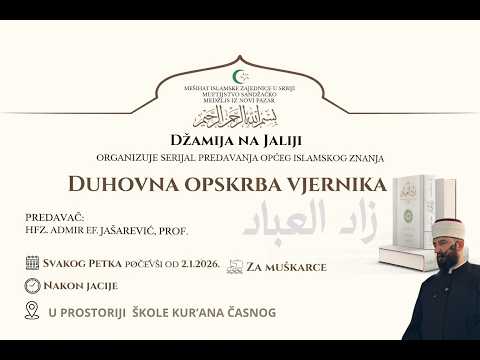
Duhovna opskrba vjernika (dio 5)
Spiritual Nourishment of the Believer
Automatski transkript (lektorisan)Automatic transcript (proofread)
Automatski transkript. Napravljen je iz zvuka snimka i lektorisan, ali nije provjeren uz slušanje— moguće su greške, naročito u imenima i arapskim citatima. Mjerodavan je video.
Machine translation. Translated from the automatic Bosnian transcript — names and Arabic quotations may be inaccurate. The video is authoritative.
- 0:00
الْحَمْدُ لِلَّهِ رَبِّ الْعَالَمِينَ وَالصَّلَاةُ وَالسَّلَامُ عَلَى نَبِيِّنَا مُحَمَّدٍ وَعَلَى آلِهِ وَصَحْبِهِ أَجْمَعِينَ
Hvala Allahu, Gospodaru svjetova, a salavat i selam na našeg Vjerovjesnika Muhammeda i na njegovu porodicu i sve njegove ashabe.
- 0:42
Zahvala pripada jedinom Uzvišenom Allahu, subhanehu ve te'ala, Gospodaru svih svjetova. Zahvala Njemu što nas je večeras okupio ovdje da izučavamo Njegovu vjeru, da samo Njega obožavamo, da slijedimo Njegovog Poslanika Muhammeda, sallallahu alejhi ve sellem. Neka je Allahovo zadovoljstvo na ashabe Poslanika Muhammeda, sallallahu alejhi ve sellem, i na sve one koji slijede njihov put.
- 1:12
Amin, ja Rabbel-alemin. Na prošlom predavanju, draga braćo, smo govorili o važnosti obožavanja samo Allaha, Jednoga, Jedinoga.
- 1:25
Pa smo rekli da je svaki poslanik koji je poslan pozivao prvo u vjerovanje, to jest u obožavanje Allaha, subhanehu ve te'ala, Jednoga, Jedinoga. I to je bila njihova prva zadaća, ili njihov prvi zadatak.
- 1:44
Kako kaže Allah, subhanehu ve te'ala, u Kur'anu: „وَمَا أَرْسَلْنَا مِنْ قَبْلِكَ مِنْ رَسُولٍ إِلَّا نُوحِي إِلَيْهِ أَنَّهُ لَا إِلَهَ إِلَّا أَنَا فَاعْبُدُونِ“ – „A nismo prije tebe poslali poslanika a da mu nismo objavili da nema božanstva koje zaslužuje da bude obožavano osim Mene“, kaže Allah, subhanehu ve te'ala, „pa Me obožavajte.“
- 2:19
Pa Me obožavajte. Pa je glavna zadaća svakog poslanika bila da poziva u obožavanje Allaha, subhanehu ve te'ala, Jednog, Jedinog. Također smo spomenuli i hadis Poslanika, sallallahu alejhi ve sellem, gdje se govori o pravu Allaha, subhanehu ve te'ala, kod Njegovih robova.
- 2:44
Pa Allah ima ovo pravo kod nas: da Ga obožavamo i da Mu ne činimo širk, da Mu ne pripisujemo saučesnika. A pravo naše kod našeg Gospodara jeste da ne kazni onoga ko kaže „La ilahe illallah“, tražeći Njegovo zadovoljstvo, tražeći da vidi Njegovo lice u Džennetu.
- 3:10
Također smo ovdje spomenuli da nije od ibadeta samo da čovjek padne na sedždu Allahu, subhanehu ve te'ala. Nije samo to od ibadeta. Ima puno ibadeta koje čovjek ne smije da radi ili da upućuje nekom drugom mimo Allaha, subhanehu ve te'ala.
- 3:33
Od tih ibadeta jeste, draga braćo, „el-isti'aze“, ili traženje zaštite. Pa možemo reći da je terminološko značenje ovog „el-isti'aze“ okretanje Allahu, oslanjanje i čvrsto pribjegavanje Njemu, traženje utočišta, zaštite kod Njega od svih zala, šteta koje mogu zadesiti jednog čovjeka.
- 4:06
Zbog čega spominjamo „el-isti'aze“? Zbog toga što je ovaj termin, „el-isti'aze“, spomenut u Kur'anu i sunnetu.
- 4:18
Pa nije dozvoljeno, to jest nije dozvoljeno tražiti zaštitu od šerra, od šejtana ili od drugih stvari osim od Allaha, subhanehu ve te'ala. Kaže Allah, subhanehu ve te'ala, u Kur'anu: „Poslaniče, Muhammede, ako te šejtan bude nagovarao na kakvo zlo, ili bude ubacivao sumnju u tvoja prsa, ili ljutnju, traži zaštitu“ – kod koga? Kod Allaha, subhanehu ve te'ala.
- 5:07
Ne kod nekog evlije, niti kod nekog kipa ili tako dalje, već kod koga? Kod Allaha, subhanehu ve te'ala. „Innehu semi'un alim“ – doista On sve čuje i sve zna.
- 5:26
Također, ajet koji dokazuje da je ovo ibadet i da se ne smije činiti, ili upućivati nekome drugome mimo Allaha, subhanehu ve te'ala, jeste ajet gdje kaže Allah, subhanehu ve te'ala: „Ve kul Rabbi e'uzu bike min hemezatiš-šejatin, ve e'uzu bike Rabbi en jahdurun.“ I reci, Muhammede: tražim zaštitu kod Allaha od nagovaranja šejtanskih, od njegovih nagovaranja, od njegovih vesvesa. „Ve e'uzu bike… en jahdurun“ –
- 6:08
i tražim od Tebe zaštitu, Gospodaru moj, od njihovog prisustva. Kako su lijepi ajeti, da ih čovjek nauči, kako bi tražio zaštitu od Allaha, subhanehu ve te'ala. Također sure, draga braćo, koje svi znamo, koje je Allah, subhanehu ve te'ala, poslao Poslaniku Muhammedu, sallallahu alejhi ve sellem, kao lijek.
- 6:33
Vi znate svi da je Poslanik, sallallahu alejhi ve sellem, bio opsihren. Znate svi da je Poslanik, sallallahu alejhi ve sellem, bio opsihren. I nije ga mimoišlo nikakvo iskušenje. A sve ovo da bismo mi, kao njegov ummet, imali koristi od toga.
- 6:52
Da bismo mi, kao njegov ummet, imali koristi od toga. Pa ga je opsihrio Jevrej po imenu Lebid sa svojim kćerima. Allah, subhanehu ve te'ala, posla obje sure: „Kul e'uzu bi Rabbil-felek“ i „Kul e'uzu bi Rabbin-nas“. I šta kaže Allah, subhanehu ve te'ala, u suri El-Felek: „Kul“ – reci, Muhammede – „e'uzu bi Rabbil-felek“ – tražim zaštitu kod Gospodara svitanja – „min šerri ma halek“ – od šerra, od zla
- 7:33
onoga što je stvorio – „ve min šerri gasikin iza vekab“ – i od šerra, ili zla, noći kada razastre tminu. Pa vi znate, vidite kako ovdje precizno – noć.
- 7:51
Većina zla se događa baš u noćima, to jest kada je noć. I stvarno, kada padne noć, onda se tad zlo širi. Jer ljudi se jednostavno ne vide, kriju se,
- 8:08
i onda rade svakakva zla. Pa, kaže Allah, subhanehu ve te'ala, ovdje poručuje Poslaniku Muhammedu, sallallahu alejhi ve sellem, da traži zaštitu od svakoga zla kod Njega. „Ve min šerri gasikin iza vekab,
- 8:24
ve min šerrin-neffasati fil-ukad“ – i tražim zaštitu kod Tebe, Gospodaru, od onih sihirbazica koje pušu u čvorove. A mi… ne, mi danas…
- 8:40
To jest, vallahi, danas se to dosta iščistilo. Nekada, vi znate, ovi stari, pa ode, pa mu lije strahu. Lije mu strahu, ili ga liječi žena koja ne zna, tako mi Allaha, jedan harf da izgovori kako treba,
- 8:58
ali zato izgovara neke riječi koje se i ne razumiju. Pa onda traži, ne znam, sliku, traži parče od odjeće i tako dalje. A to su sve znaci da je ta osoba sihirbaz,
- 9:18
i da radi sa džinnima, šejtanima. Pa nas je Allah, subhanehu ve te'ala, preko Njegovog Poslanika ovdje naučio kako da se štitimo od ovih zala. „Ve min šerrin-neffasati fil-ukad, ve min šerri hasidin iza hased“ –
- 9:34
i od šerra, i od zla zavidnika – ali ne svakog zavidnika: onoga koji zavidi. Imate ljudi koji zavide, ali ne žele zlo, ne prelazi ta zavist njegova na druge. A imate zavidnika koji zavidi i želi da uništi onoga kome zavidi.
- 9:56
Kako je Allah, subhanehu ve te'ala, ovom surom obuhvatio, kako je Allah, subhanehu ve te'ala, ovu suru poslao kao lijek čovjeku preko Poslanika Muhammeda, sallallahu alejhi ve sellem. I ja nikako, draga braćo, ne razumijem ljude: dođe čovjek iz Sandžaka, iz Bosne, do Medine, i šta uradi?
- 10:22
Počini širk, nevjerstvo, kod mezara Poslanika Muhammeda, sallallahu alejhi ve sellem, tražeći od Poslanika zaštitu, ili tražeći od mrtvoga, našega Poslanika, da se zauzima za njega. To je nevjerovatno. Pa Poslanik, sallallahu alejhi ve sellem, da je mogao samoga sebe da izliječi,
- 10:42
ne bi mu Allah, subhanehu ve te'ala, slao ove sure, već bi Poslanik, sallallahu alejhi ve sellem, samoga sebe izliječio. Ali ne. Poslanik, sallallahu alejhi ve sellem, kao i mi, ne može sebi da pribavi nikakvu korist, niti da otkloni štetu,
- 11:05
osim onoliko koliko mu je Allah, subhanehu ve te'ala, propisao, i nama također. Također, sura En-Nas – također lijek. Kaže Allah, subhanehu ve te'ala, obraćajući se Poslaniku, a i njegovom ummetu: „Kul e'uzu bi Rabbin-nas“ –
- 11:23
reci, o Muhammede: tražim zaštitu kod Gospodara ljudi – „Melikin-nas“ – Vladara ljudi – „Ilahin-nas“ – njihovog Božanstva – „min šerril-vesvasil-hannas“ – od šerra, od zla šejtana, koji, kada se Allahovo ime spomene, brzo pobjegne, ne stane.
- 11:48
Pa vidimo ovdje, znači, dokaz da, kada se Allahovo ime spomene, šejtan brzo, brzo pobjegne. „Ellezi juvesvisu fi sudurin-nas“ – koji ubacuje sumnju u prsa ljudi,
- 12:06
sumnju, nevjerstvo i tako dalje. „Minel-džinneti ven-nas“ – od džinna i ljudi. Također, ovdje imamo dokaz da ima šejtana od ljudi i šejtana od džinna. Pa će se neko zapitati: kako imamo šerr, ili kako se dešava u mjesecu ramazanu od šerra ono što se dešava, kada su šejtani povezani?
- 12:40
Je l' nas nije Poslanik Muhammed, sallallahu alejhi ve sellem, obavijestio da se šejtani povežu u mjesecu ramazanu? Jeste. Ali, imate, ostaju ovi šejtani od ljudi. Šejtani od ljudi. Šejtani od ljudi koji hodaju.
- 12:57
Pa kada je Poslanik, sallallahu alejhi ve sellem, bio upitan, kaže: „Ima li šejtana od ljudi?“, kaže Poslanik: „Ima. Ima.“ Pa čovjek treba da uči ove dvije sure kao lijek i da traži zaštitu samo od Allaha, subhanehu ve te'ala. Prenosi se u hadisu kojeg prenosi Abdullah ibn Abbas, a bilježi ga Buhari, da ih je Poslanik, sallallahu alejhi ve sellem, učio dovi; kaže: „Učio nas je ovoj dovi kao što nas je učio suri El-Bekare.“
- 13:30
Koja je to dova, draga braćo? To je dova koja se uči na kraju svakog namaza. Kaže Poslanik, sallallahu alejhi ve sellem: „Kulu“ – recite – „Allahumme inna ne'uzu bike min azabi džehennem.“
- 13:45
Allahu moj, tražim kod Tebe zaštitu od džehennemske, od džehennemske kazne. Od džehennemske kazne. Kako vidite, znači prvo Poslanik, sallallahu alejhi ve sellem, kaže da tražimo zaštitu od džehennemske vatre.
- 14:03
Od koga da tražimo zaštitu? Od Allaha, subhanehu ve te'ala. Ne smijemo da tražimo zaštitu od nekoga drugog od džehennemske vatre. Vidite, vjerujte, ljudi koji traže zaštitu od džehennemske vatre od nekog evlije, od nekog džinna, od nekog petog, devetog,
- 14:21
zaboravljaju Allaha, subhanehu ve te'ala. A zaboravljaju, a zaboravljaju Allaha, subhanehu ve te'ala. A prvo od čega čovjek treba da traži zaštitu jeste Džehennem. I to je osobina pametnih ljudi, kako to kaže Allah, subhanehu ve te'ala, u Kur'anu: „الَّذِينَ يَذْكُرُونَ اللَّهَ قِيَامًا وَقُعُودًا وَعَلَى جُنُوبِهِمْ“ –
- 14:41
oni, kaže, koji spominju Allaha, subhanehu ve te'ala, stojeći i sjedeći, i sjedeći i na bokovima – „وَيَتَفَكَّرُونَ فِي خَلْقِ السَّمَاوَاتِ وَالْأَرْضِ“ [nejasno] „رَبَّنَا مَا خَلَقْتَ هَذَا بَاطِلًا“ [nejasno] „رَبَّنَا مَا خَلَقْتَ هَذَا بَاطِلًا سُبْحَانَكَ“ [nejasno] „فَقِنَا عَذَابَ النَّارِ“ –
- 15:23
tražimo od Tebe zaštitu od džehennemske vatre. Druga stvar koju spominje Poslanik, sallallahu alejhi ve sellem, kaže: i kaže: tražimo kod Tebe zaštitu od iskušenja, ili kazne kaburske, ili patnje kaburske. Pa je kaburska patnja jedno od najvećih iskušenja za čovjeka, jedno od najvećih iskušenja za čovjeka. Kada dođu Munkir i Nekir i budu upitali čovjeka, nakon što se njegova porodica,
- 16:04
njegovi prijatelji udalje od mezarja – dođu Munkir i Nekir i upitaju ga tri stvari. Prva stvar jeste: „Ko ti je bio Gospodar? Koga si obožavao na ovome dunjaluku?“ Druga stvar jeste: „Koja ti je bila vjera?“
- 16:20
Treća stvar jeste: „Ko ti je bio poslanik?“ Znate, mi nekad mislimo: lahko ćemo to da odgovorimo. I nekad mislimo: lahko ćemo mi to da odgovorimo. Sad bilo koga od nas ovdje da pitate, sigurno će odgovoriti,
- 16:36
to jest, bit će tačan odgovor. Ali ne: u kaburu čovjek neće odgovarati onako kako bi odgovorio na ovome dunjaluku, nego shodno njegovim djelima i njegovom vjerovanju. Znači, shodno onako kako smo radili, tako ćemo i da odgovorimo u kaburu.
- 16:55
Pa je to jedno od najvećih iskušenja za čovjeka. A čovjek treba da traži zaštitu. Vidite kako je Poslanik, sallallahu alejhi ve sellem, koji je bio najbolje stvorenje, tražio zaštitu od kaburske patnje.
- 17:13
Pa šta onda da radimo mi, draga braćo? Ovo treba čovjek da nauči. I kaže: Poslanik, sallallahu alejhi ve sellem, učio ih je ovim stvarima kao što ih je podučavao suri El-Bekare. Mi znamo da je sura El-Bekare najveća sura u Kur'anu, i da u suri El-Bekare ima najbolji ajet, najveličanstveniji ajet, Ajetul-kursija.
- 17:31
Ili, kao što mi govorimo, „Te'svih-dova“. Također, kaže Poslanik, sallallahu alejhi ve sellem: „وَنَعُوذُ بِكَ مِنْ فِتْنَةِ الْمَسِيحِ الدَّجَّالِ“ – i kaže: naučite da tražite zaštitu kod Allaha od fitne, ili iskušenja, Dedžala.
- 17:47
Svi znamo ko je Dedžal. Dedžal je prvi predznak, veliki predznak od predznaka Sudnjeg dana. Pa kaže Poslanik, sallallahu alejhi ve sellem, da je to najveće iskušenje čovječanstvu, od Adema do kraja svijeta.
- 18:05
To je najveće iskušenje, ovo dunjalučko iskušenje. Pa je Poslanik, sallallahu alejhi ve sellem, tražio zaštitu od Dedžala, koji će prekrivati istinu neistinom, koji će se predstavljati kao božanstvo, kojeg će slijediti Jevreji, i, naravno, najviše njegovih sljedbenika će biti od žena,
- 18:35
kako se spominje u predajama. I na kraju kaže Poslanik, sallallahu alejhi ve sellem: „وَنَعُوذُ بِكَ مِنْ فِتْنَةِ الْمَحْيَا وَالْمَمَاتِ“ – i kaže: utječem se, ili tražim zaštitu kod Tebe, Gospodaru moj, od iskušenja života i smrti.
- 18:53
Šta ovo znači, draga braćo? Ovo znači da čovjek treba da traži zaštitu od iskušenja koja će ga pogoditi u životu. A vi znate, tokom života čovjeka razna iskušenja, ovaj, pogađaju.
- 19:11
Imate iskušenja ispred kojih čovjek stoji, a to su grijesi. Pa su grijesi nekim ljudima iskušenje. Ili nije tako? Kada mu dođe lijepa žena, kada mu dođe alkohol i tako dalje – sve to je iskušenje.
- 19:28
Pa čovjek treba… Nekome je novac iskušenje, nekome je nešto drugo iskušenje. Pa je na čovjeku da traži zaštitu od ovih stvari. Od koga? Od Allaha, subhanehu ve te'ala. Također, također kaže: iskušenje, i da tražimo zaštitu od iskušenja, iskušenja smrti.
- 19:51
Šta ovo znači, draga braćo? Da tražimo zaštitu od iskušenja kada dođe melek, kada dođe melek smrti. A to je veliko iskušenje, najveće iskušenje, kada dođe melek smrti: hoće li čovjek u tim trenucima reći „La ilahe illallah“ i preseliti kao vjernik, ili će preseliti kao nevjernik?
- 20:14
Vi znate da će doći vrijeme pred krajem ovog svijeta kada će čovjek zanoćiti kao vjernik, a probuditi se kao nevjernik. Vjerujte, draga braćo, ja sam to viđao, viđao sam takve ljude, da nauče, draga braćo, po dva džuza Kur'ana, i samo odjednom – nema.
- 20:38
Zanevjeruje u Allaha, subhanehu ve te'ala, Njegovo postojanje, u sve. Zbog toga je mnogo bitno da čovjek nauči ovu dovu, da zna od čega da traži zaštitu. Također, od ibadeta, od ibadeta, draga braćo, jeste traženje, traženje pomoći, traženje pomoći.
- 21:00
Ovdje ne govorimo, draga braćo, o pomoći koju svako od nas traži od svoga brata muslimana koji je u mogućnosti da mu pomogne, već ovdje govorimo o nečemu što ne može čovjeku da pribavi niko osim Allaha, subhanehu ve te'ala. Pa ili može neko da produži naš život osim Allaha, subhanehu ve te'ala? Ne može čovjek ako traži to od nekog drugog. Ili da ga sačuva džehennemske vatre – to može samo Allah, subhanehu ve te'ala. Pa dokaz, dokaz da je ovo ibadet jeste i ajet kojeg svakodnevno učimo, nema rekata da ga ne učimo: „Ijjake na'budu“ –
- 21:41
samo Tebe obožavamo, ili ne obožavamo nikoga drugoga osim Tebe – „ve ijjake neste'in“ – i samo od Tebe pomoć tražimo. Pa Allah, subhanehu ve te'ala, da nije htio da tražimo pomoć od Njega, On nam ne bi objavio ove ajete. A ovo se u arapskom naziva „el-hasr“, to jest ograničenje: da samo od Allaha, subhanehu ve te'ala, tražimo, tražimo, tražimo. Pa ova prva rečenica, „ijjake na'budu“, jeste odricanje od lažnih božanstava; „ve ijjake neste'in“ – i od Tebe pomoć tražimo – jeste odricanje
- 22:22
od svoje moći, od svoje snage, i prepuštanje sebe samoga Allahu, subhanehu ve te'ala. Također, hadis koji ukazuje da je ovo ibadet, ili traženje pomoći od Allaha, jeste i hadis, prelijep hadis, kojem trebamo da učimo svoju djecu, kojeg prenosi Abdullah ibn Abbas.
- 22:48
Kaže: „Bio sam iza Poslanika Muhammeda, sallallahu alejhi ve sellem“, to jest išao sam iza Poslanika Muhammeda, sallallahu alejhi ve sellem. Ibn Abbas je bio mali, skroz. Pa mi danas, kada hoćemo nešto našoj djeci da kažemo, kažemo: „Nema veze, on je mali.“ Kaže: „Nema veze, on je mali još, neće on to da razumije.“
- 23:07
I onda dođe vakat, kada poraste, da baš neće da razumije, ne želi da razumije. Zato, draga braćo, djeca se vaspitavaju od malih nogu. Pa vidimo, ovo je primjer, primjer Poslanika, sallallahu alejhi ve sellem. Nema ljepšeg primjera od primjera Poslanika Muhammeda, sallallahu alejhi ve sellem. Šta mu kaže Poslanik, sallallahu alejhi ve sellem?
- 23:23
Kaže: „O dječače“, kaže, „naučit ću te riječima.“ Prvo što ga uči Poslanik, sallallahu alejhi ve sellem, kaže: „Ihfezillahe jahfezke“ – čuvaj Allaha, Allah će tebe čuvati.
- 23:39
Šta znači, draga braćo? Kaže Poslanik, to jest kaže ulema: ovo znači čuvaj Allahove granice, drži se onoga što ti je Allah, subhanehu ve te'ala, naredio i kloni se onoga što ti je zabranio – On će te čuvati.
- 23:59
احْفَظِ اللَّهَ تَجِدْهُ تُجَاهَكَ
„Čuvaj Allaha, naći ćeš Ga pred sobom.“ (hadis, Tirmizi)
- 24:03
„Čuvaj Allaha, naći ćeš Ga pored sebe“, to jest naći ćeš Ga kao pomagača u svakoj situaciji. Ako budeš čuvao Njegove granice i ne budeš prelazio Njegove granice, On će te pomagati u svakoj situaciji.
- 24:22
Pa je ovo obećanje Allaha, subhanehu ve te'ala. Ovo je obećanje Allaha, subhanehu ve te'ala, preko Njegovoga Poslanika. A on ne govori, to jest Poslanik, sallallahu alejhi ve sellem, ne govori po svome nahođenju,
- 24:38
već je to objava koja mu se objavljuje od njegovog Gospodara. Šta kaže dalje Poslanik, sallallahu alejhi ve sellem? Kaže: „Ako tražiš nešto, traži od Allaha.“ Zbog čega? Zbog toga što je Allah, subhanehu ve te'ala,
- 24:54
najbolji Onaj koji daje i najbolji Onaj od koga se traži nešto. Allah, subhanehu ve te'ala, neće vratiti prazne ruke vjernika koji Ga moli. Pa ako mu ne da na ovome dunjaluku – a Allah zna zbog čega mu ne da neku stvar – On će mu je sigurno dati na onome svijetu.
- 25:16
Kaže dalje: „وَإِذَا اسْتَعَنْتَ فَاسْتَعِنْ بِاللَّهِ“ – i kaže: kada tražiš pomoć, traži je samo od Allaha. Zbog čega? Dolazi objašnjenje nakon toga, kaže: „Ve'lem ennel-ummete levidžteme'at ala en jenfe'uke bi šej'in lem jenfe'uke illa bi šej'in kad ketebehullahu lek“ – i znaj, i znaj, da kada bi se cijeli dunjaluk sakupio da ti kakvu korist
- 25:57
pribavi, ne bi ti je mogli pribaviti osim onoliko koliko ti je Allah propisao. Dokaz, draga braćo: ona naša sestra koja je preselila prije nekoliko… Je l' se nismo svi sakupili da joj pomognemo u bolesti, da joj olakšamo, da ode na operaciju?
- 26:21
Ali gotovo, Allah joj nije propisao. Džaba što smo se mi sakupili, pokupili novac.
- 26:33
Jednostavno, Allah nije propisao. I tako, kaže dalje: „Ve inidžteme'u ala en jadurruke bi šej'in lem jadurruke illa bi šej'in kad ketebehullahu alejk.“ I kaže: kada bi se sastavili svi da ti načine kakvu štetu,
- 26:53
kaže, ne bi ti je mogli načiniti osim onoliko koliko ti je Allah, subhanehu ve te'ala, to propisao. Ne može. Propisao je Allah, zapisao.
- 27:07
„Podignuta su pera, a listovi su se osušili.“ To jest, Allah je zapisao sudbinu čovjeka 50.000 godina prije nego što je stvorio nebesa i Zemlju.
- 27:24
Pa čovjek ne mora i ne smije da se plaši za budućnost. Ima, vjerujte, ljudi koji se plaše, kažu: „Šta ću ja kad ostarim? Hoću li ostati sam? Hoće li me djeca napustiti?“ Prvo, ko nam obećava da ćemo dočekati starost? Drugo, ko nam kaže, ili od čega strahujemo, da će nas djeca napustiti, ili hanuma, ili da ćemo ostati sami da živimo i tako dalje?
- 27:50
O tome čovjek ne treba da razmišlja. Zbog toga sve ovo, sve ovo – da se čovjek osloni na Allaha i da traži pomoć od Allaha i zaštitu od Allaha, subhanehu ve te'ala. Također, draga braćo, jedan od lijepih ibadeta jeste prinošenje kurbana.
- 28:15
Prinošenje kurbana jedino Allahu, subhanehu ve te'ala. Pa je to jedan od najljepših ibadeta, to je jedan od najljepših ibadeta. Kaže Allah, subhanehu ve te'ala, obraćajući se Svome Poslaniku – pošto, vi znate, da su mušrici prinosili kurban, ili žrtvu, svojim kipovima,
- 28:42
svojim kipovima, njima se klanjali – pa Allah, subhanehu ve te'ala, poručuje Svom Poslaniku da prenese Kurejšijama, mušricima, ove riječi: „Kul“ – reci, Muhammede – „inne salati“ – doista moj namaz – „ve nusuki“ – i moj kurban, moje prinošenje žrtve – „ve mahjaje“ – i moj život – „ve memati“ – i moja smrt – „lillahi Rabbil-alemin“ – pripadaju samo Allahu, subhanehu ve te'ala. „La šerike leh“ –
- 29:23
nema saučesnika. „Ve bi zalike umirtu“ – i ovo mi je naređeno – „ve ene evvelul-muslimin“ – a ja sam prvi musliman od ovog ummeta, kaže Poslanik, sallallahu alejhi ve sellem, prvi musliman od ovog ummeta. Vidimo ovdje, ovdje, kako je Allah, subhanehu ve te'ala, nakon namaza spomenuo klanje kurbana. I to je dokaz koliko je to velik i lijep ibadet. I vjerujte, draga braćo, da mi je jedan od najljepših trenutaka u godini kada za vrijeme Kurban-
- 30:03
bajrama želim da prinesem Allahu, subhanehu ve te'ala, žrtvu zajedno sa svojom porodicom. To je najljepši trenutak. Pa čovjek ne smije da kolje žrtvu, kurban, nekome drugome mimo Allaha, subhanehu ve te'ala. Ako to uradi, onda je on mušrik, nevjernik – gotovo sa njim, gotovo, gotovo, gotovo sa njim. Draga braćo, također je mnogo bitno, kad čovjek kolje kurban, ili ne samo kurban, bilo šta drugo – znači, ako čovjek kolje, ne znam,
- 30:44
kravu, kako bi prehranio svoju porodicu, znači mora da spomene Allahovo ime, da to bude radi Allaha. Šta kaže Allah, subhanehu ve te'ala? I kaže: „Nemojte da jedete ono što je zaklano, a nije spomenuto Allahovo ime – ve innehu le fisk“ – doista je to nepokornost. To je nepokornost Allahu, subhanehu ve te'ala. Zato i također učimo suru „Inna a'tajnakel-Kevser“ – doista smo Mi tebi dali rijeku Kevser
- 31:26
u Džennetu – „fe salli li Rabbike venhar“ – pa klanjaj Allahu, to jest obavljaj Mu namaz, i kurban kolji, to jest prinosi Mu žrtvu. Vidimo i ovdje da je Allah, subhanehu ve te'ala, poslije namaza spomenuo prinošenje žrtve, to jest kurban. Koliko je to lijep, prelijep, prelijep ibadet! Prenosi se od Ebu Tufejla – a Ebu Tufejl, on je bio ashab, a mnogo se družio sa Alijom, to jest učio je od Alije, radijallahu te'ala anhu – pa upita jedne prilike ovaj Ebu Tufejl Aliju, radijallahu te'ala anhu, kaže: „Alija, je li vam Allah, subhanehu ve te'ala, vama, ili tebi i porodici njegovoj,
- 32:11
dao neko znanje mimo drugih ljudi? Je l' vi znate nešto što drugi ljudi ne znaju, što drugi ashabi ne znaju?“ Zbog čega ovo pitanje, draga braćo? Vi znate da šiije, rafidije, neki idu toliko daleko da obožavaju Aliju, i misle da je Poslanik Muhammed, sallallahu alejhi ve sellem, dao Aliji neko znanje koje nije dao drugim ashabima,
- 32:44
to jest da mu je Poslanik Muhammed, sallallahu alejhi ve sellem, nešto ispričao što nije ispričao drugim ashabima. Pa Alija, radijallahu anhu, pobija ove tvrdnje, kaže: „Nije, osim jednu stvar, osim jednu stvar.“ Pa, kaže, izvadi papir iz korica svoje sablje na kojem piše, kaže: „Allah je prokleo onoga ko zakolje, ili prinese kurban, nekome drugome mimo Allaha.“
- 33:21
Zbog čega Alija ovo kaže? Zbog toga što je on čuo hadis od Poslanika. Alija je bio jedan od najučenijih ashaba, jedan od najučenijih, jer je on bio mlad kada je došla objava Poslaniku, sallallahu alejhi ve sellem, pa je brzo pamtio.
- 33:40
Brzo je pamtio i hadise i sve. I onda kaže: „Allah je prokleo“, kaže, „onoga ko zakolje nešto u nečije drugo ime, a ne u Allahovo, u Allahovo ime.“ Pa je prinošenje kurbana ibadet, draga braćo. I zadnja stvar koju ćemo danas, ako Bog da, spomenuti jeste zavjet. Zavjet. Zavjet, ili ovaj „nezr“ u islamu, jeste ono što čovjek sam sebi stavi u obavezu
- 34:22
od pokornosti. Znači, nije mu Allah, subhanehu ve te'ala, stavio u obavezu to, već je čovjek sam sebi stavio to u obavezu. Kao, na primjer, čovjek da kaže: „Zavjetujem se: ako mi Allah izliječi ovo moje dijete, da ću postiti svaki dan.“
- 34:46
Mora da posti. To jest: „Zavjetujem se.“ Pa nije dozvoljeno da čovjek daje zavjet nekom drugom mimo Allaha, subhanehu ve te'ala.
- 34:59
Ne možeš da kažeš: „Zavjetujem se: ako mi ovaj evlija, ili taj u kaburu, izliječi dijete, ja ću da [nejasno].“ Ne možeš. Znači, mora da kažeš: ovo samo pripada Allahu, subhanehu ve te'ala.
- 35:16
Čovjek, kada da zavjet Allahu, subhanehu ve te'ala, mora da ga ispuni. A svi smo mi možda nekad dali neki zavjet Allahu, subhanehu ve te'ala. Allah, subhanehu ve te'ala, hvali te ljude u Kur'anu, kaže: „Jufune bin-nezri“ – kaže: ispunjavaju zavjet – „ve jehafune jevmen kane šerruhu mustetira“ – i takvi ljudi, kaže, se boje dana čiji će ovaj… dana kada će njegov šerr, ili šerr tog dana, ili zlo tog dana, biti rasprostranjeno, to jest Sudnjeg dana, strahota Sudnjeg dana. Pa se ti ljudi boje strahota Sudnjeg, Sudnjeg dana i ispunjavaju svoje zavjete.
- 35:58
Prenosi Aiša, radijallahu te'ala anha, kaže: „Men nezere en juti'allahe feljuti'hu“ – kaže: onaj ko se zavjetuje da je pokoran Allahu, subhanehu ve te'ala – kao primjer koji smo malo spomenuli, malo prije spomenuli – kaže: „neka Ga slijedi, neka Mu je pokoran“; a, kaže, „onaj ko se zavjetuje da Mu bude nepokoran, ili da Mu griješi, ne može to da radi.“
- 36:26
Pa ako se čovjek zavjetuje da bude nepokoran Allahu, subhanehu ve te'ala, ne smije to da ispuni. Kao: čovjek se zavjetuje da će da uradi neki grijeh: „Uradit ću taj i taj grijeh, ako mi se desi to i to, zavjetujem se Allahu.“ Ne može tako. To je neispravno.
- 36:43
I to je neispravan zavjet, i čovjek treba toga da se kloni. Danas smo, draga braćo, završili sa jednim mnogo bitnim… a to je poglavlje koje govori o bitnosti ibadeta i obožavanja samo Allaha, subhanehu ve te'ala.
- 37:07
Ako Bog da, sljedeće hefte nastavljamo, i to će biti ujedno i zadnje predavanje prije mjeseca ramazana. U mjesecu ramazanu imamo svoje aktivnosti, gdje ćemo imati prije svakog sabaha jedno kratko predavanje, a nakon, ako Bog da, ramazana nastavljamo sa ovom prelijepom knjigom koja govori o osnovama vjere.
- 37:35
Ja razumijem da možda je nekad čovjeku… ove stvari, posebno kad dođu fikhske stvari, ili stvari vezane za abdest, za namaz ili tako dalje, možda će nekome biti malo i dosadno, iz razloga što većina ljudi, to jest većina nas, zna te stvari. Ali te stvari su mnogo bitne, da ih čovjek malo bolje utvrdi, kako bi sutra mogao svoju porodicu da poduči.
- 38:00
Ovo, draga braćo, što naučite ovdje, ili ovo što čujete ovdje, ovo bi trebao čovjek da zapamti, pa sutra da upozori nekoga iz svoje porodice ili nekoga od svojih bližnjih. Jer svi smo mi, draga braćo, pozivači u Allahovu vjeru. Šta nas je ovdje? Šaka, što bi rekli naši, šaka duša.
- 38:23
Šaka duša. Koliko ima ljudi koji su trenutno napolju, koje ne zanima ni vjera, ni džamija, ni ništa ih ne zanima. Zbog toga, draga braćo, mi smo ti koji trebamo, trebamo da podučavamo ljude ovim stvarima kada izađemo napolje.
- 38:43
Kada izađemo napolje, da predočimo ljudima ovo u najljepšem svjetlu. I svi smo mi, svi smo mi pozivači, i svi smo mi svjedoci da sam ja ovo vama prenio, pa i vi prenesite drugima. Molim Allaha, subhanehu ve te'ala, da nas učini od Njegovih iskrenih, dobrih robova. Molim Njega Uzvišenog da nas sačuva džehennemske vatre. Molim Njega Uzvišenog da samo Njega obožavamo. Amin, ja Rabbel-alemin.
- 0:00
الْحَمْدُ لِلَّهِ رَبِّ الْعَالَمِينَ وَالصَّلَاةُ وَالسَّلَامُ عَلَى نَبِيِّنَا مُحَمَّدٍ وَعَلَى آلِهِ وَصَحْبِهِ أَجْمَعِينَ
Praise be to Allah, Lord of the worlds, and blessings and peace be upon our Prophet Muhammad and upon his family and all his companions.
- 0:42
Praise belongs to the One, Exalted Allah, subhanahu wa ta'ala (glorified and exalted is He), Lord of all the worlds. Praise be to Him for gathering us here this evening to study His religion, to worship Him alone, and to follow His Messenger Muhammad, sallallahu alayhi wa sallam (peace be upon him). May Allah's pleasure be upon the companions of the Prophet Muhammad, sallallahu alayhi wa sallam, and upon all those who follow their path.
- 1:12
Amin, ya Rabb al-alamin. In the last lecture, dear brothers, we spoke about the importance of worshipping Allah alone, the One, the Only.
- 1:25
And we said that every messenger who was sent called first to belief, that is, to the worship of Allah, subhanahu wa ta'ala, the One, the Only. And that was their first duty, or their first task.
- 1:44
As Allah, subhanahu wa ta'ala, says in the Qur'an: “وَمَا أَرْسَلْنَا مِنْ قَبْلِكَ مِنْ رَسُولٍ إِلَّا نُوحِي إِلَيْهِ أَنَّهُ لَا إِلَهَ إِلَّا أَنَا فَاعْبُدُونِ” – “And We did not send before you any messenger except that We revealed to him that there is no deity worthy of worship except Me,” says Allah, subhanahu wa ta'ala, “so worship Me.”
- 2:19
So worship Me. So the main task of every messenger was to call to the worship of Allah, subhanahu wa ta'ala, the One, the Only. We also mentioned the hadith of the Prophet, sallallahu alayhi wa sallam, which speaks about the right of Allah, subhanahu wa ta'ala, over His servants.
- 2:44
So Allah has this right over us: that we worship Him and do not commit shirk with Him, that we do not ascribe partners to Him. And our right with our Lord is that He does not punish the one who says “La ilaha illallah”, seeking His pleasure, seeking to see His Face in Jannah (Paradise).
- 3:10
We also mentioned here that worship is not only that a person falls into prostration before Allah, subhanahu wa ta'ala. That is not the only act of worship. There are many acts of worship that a person must not perform for, or direct to, anyone other than Allah, subhanahu wa ta'ala.
- 3:33
Among those acts of worship, dear brothers, is “al-isti'adhah”, or seeking protection. We can say that the technical meaning of “al-isti'adhah” is turning to Allah, relying on Him and firmly resorting to Him, seeking refuge and protection with Him from all evils and harms that can befall a person.
- 4:06
Why do we mention “al-isti'adhah”? Because this term, “al-isti'adhah”, is mentioned in the Qur'an and the Sunnah.
- 4:18
So it is not permissible, that is, it is not permissible to seek protection from evil, from Satan or from other things, except with Allah, subhanahu wa ta'ala. Allah, subhanahu wa ta'ala, says in the Qur'an: “O Messenger, O Muhammad, if Satan incites you to some evil, or casts doubt into your chest, or anger, seek protection” – with whom? With Allah, subhanahu wa ta'ala.
- 5:07
Not with some saint, nor with some idol and so on, but with whom? With Allah, subhanahu wa ta'ala. “Innahu sami'un alim” – indeed, He is All-Hearing, All-Knowing.
- 5:26
Also, a verse that proves that this is worship and that it must not be done for, or directed to, anyone other than Allah, subhanahu wa ta'ala, is the verse in which Allah, subhanahu wa ta'ala, says: “Wa qul Rabbi a'udhu bika min hamazat ash-shayatin, wa a'udhu bika Rabbi an yahdurun.” And say, O Muhammad: I seek protection with Allah from the incitements of the devils, from his incitements, from his whisperings. “Wa a'udhu bika… an yahdurun” –
- 6:08
and I seek protection with You, my Lord, from their presence. How beautiful these verses are, for a person to learn them so that he may seek protection from Allah, subhanahu wa ta'ala. Also the surahs, dear brothers, that we all know, which Allah, subhanahu wa ta'ala, sent to the Prophet Muhammad, sallallahu alayhi wa sallam, as a cure.
- 6:33
You all know that the Prophet, sallallahu alayhi wa sallam, was afflicted by magic. You all know that the Prophet, sallallahu alayhi wa sallam, was afflicted by magic. And no trial passed him by. And all of this so that we, as his ummah, would benefit from it.
- 6:52
So that we, as his ummah, would benefit from it. He was bewitched by a Jew named Labid, together with his daughters. Allah, subhanahu wa ta'ala, sent both surahs: “Qul a'udhu bi Rabb al-falaq” and “Qul a'udhu bi Rabb an-nas”. And what does Allah, subhanahu wa ta'ala, say in Surah Al-Falaq: “Qul” – say, O Muhammad – “a'udhu bi Rabb al-falaq” – I seek protection with the Lord of the daybreak – “min sharri ma khalaq” – from the evil, from the harm
- 7:33
of what He has created – “wa min sharri ghasiqin idha waqab” – and from the evil, or harm, of the night when it spreads its darkness. And you know, you see how precise it is here – the night.
- 7:51
Most evil happens precisely at night, that is, when it is night. And truly, when night falls, that is when evil spreads. Because people simply cannot see each other, they hide,
- 8:08
and then they do all kinds of evil. So Allah, subhanahu wa ta'ala, here tells the Prophet Muhammad, sallallahu alayhi wa sallam, to seek protection with Him from every evil. “Wa min sharri ghasiqin idha waqab,
- 8:24
wa min sharri an-naffathati fil-'uqad” – and I seek protection with You, Lord, from those sorceresses who blow on knots. And we… no, we today…
- 8:40
That is, wallahi, today this has been cleaned up quite a bit. In the past, you know, these old folks – someone would go and have lead poured for him against fright. Lead is poured for him against fright, or he is treated by a woman who, by Allah, cannot pronounce a single letter properly,
- 8:58
but instead she utters some words that cannot even be understood. And then she asks for, I don't know, a picture, a piece of clothing and so on. And these are all signs that this person is a sorcerer,
- 9:18
and that she works with jinn, with devils. So Allah, subhanahu wa ta'ala, through His Messenger, taught us here how to protect ourselves from these evils. “Wa min sharri an-naffathati fil-'uqad, wa min sharri hasidin idha hasad” –
- 9:34
and from the evil, the harm of the envier – but not every envier: the one who envies. There are people who envy but do not wish harm; their envy does not pass on to others. And there is the envier who envies and wants to destroy the one he envies.
- 9:56
How comprehensively Allah, subhanahu wa ta'ala, covered everything with this surah, how Allah, subhanahu wa ta'ala, sent this surah as a cure for mankind through the Prophet Muhammad, sallallahu alayhi wa sallam. And I simply cannot understand people, dear brothers: a man comes from the Sandžak, from Bosnia, to Medina, and what does he do?
- 10:22
He commits shirk, disbelief, at the grave of the Prophet Muhammad, sallallahu alayhi wa sallam, seeking protection from the Prophet, or asking the dead, our Prophet, to intercede for him. That is unbelievable. If the Prophet, sallallahu alayhi wa sallam, could have cured himself,
- 10:42
Allah, subhanahu wa ta'ala, would not have sent him these surahs; rather, the Prophet, sallallahu alayhi wa sallam, would have cured himself. But no. The Prophet, sallallahu alayhi wa sallam, like us, cannot bring himself any benefit or ward off harm,
- 11:05
except as much as Allah, subhanahu wa ta'ala, has decreed for him, and for us as well. Also, Surah An-Nas – also a cure. Allah, subhanahu wa ta'ala, says, addressing the Prophet and his ummah as well: “Qul a'udhu bi Rabb an-nas” –
- 11:23
say, O Muhammad: I seek protection with the Lord of mankind – “Malik an-nas” – the King of mankind – “Ilah an-nas” – their God – “min sharri al-waswas al-khannas” – from the evil, the harm of Satan, who, when Allah's name is mentioned, quickly flees and does not stay.
- 11:48
So we see here, then, a proof that when Allah's name is mentioned, Satan quickly, quickly flees. “Alladhi yuwaswisu fi suduri an-nas” – who casts doubt into the chests of people,
- 12:06
doubt, disbelief and so on. “Min al-jinnati wan-nas” – from among the jinn and mankind. Also, here we have proof that there are devils from among humans and devils from among the jinn. So someone will ask: how is there evil, or how does the evil that happens occur in the month of Ramadan, when the devils are chained?
- 12:40
Did the Prophet Muhammad, sallallahu alayhi wa sallam, not inform us that the devils are chained in the month of Ramadan? He did. But there remain these devils from among humans. Devils from among humans. Devils from among humans who walk about.
- 12:57
When the Prophet, sallallahu alayhi wa sallam, was asked: “Are there devils from among humans?”, the Prophet said: “There are. There are.” So a person should recite these two surahs as a cure and seek protection only from Allah, subhanahu wa ta'ala. It is narrated in a hadith reported by Abdullah ibn Abbas, and recorded by Bukhari, that the Prophet, sallallahu alayhi wa sallam, taught them a supplication; he said: “He taught us this supplication as he taught us Surah Al-Baqarah.”
- 13:30
Which supplication is that, dear brothers? It is the supplication recited at the end of every prayer. The Prophet, sallallahu alayhi wa sallam, said: “Qulu” – say – “Allahumma inna na'udhu bika min 'adhabi jahannam.”
- 13:45
O my Allah, I seek protection with You from the punishment of Jahannam (Hellfire), from the punishment of Jahannam. From the punishment of Jahannam. As you see, the Prophet, sallallahu alayhi wa sallam, first says that we should seek protection from the Fire of Jahannam.
- 14:03
With whom should we seek protection? With Allah, subhanahu wa ta'ala. We must not seek protection from the Fire of Jahannam with anyone else. You see, believe me, people who seek protection from the Fire of Jahannam with some saint, with some jinn, with some fifth or ninth one,
- 14:21
forget Allah, subhanahu wa ta'ala. They forget, they forget Allah, subhanahu wa ta'ala. And the first thing a person should seek protection from is Jahannam. And that is a quality of people of understanding, as Allah, subhanahu wa ta'ala, says in the Qur'an: “الَّذِينَ يَذْكُرُونَ اللَّهَ قِيَامًا وَقُعُودًا وَعَلَى جُنُوبِهِمْ” –
- 14:41
those, He says, who remember Allah, subhanahu wa ta'ala, standing and sitting, and sitting and lying on their sides – “وَيَتَفَكَّرُونَ فِي خَلْقِ السَّمَاوَاتِ وَالْأَرْضِ” [unclear] “رَبَّنَا مَا خَلَقْتَ هَذَا بَاطِلًا” [unclear] “رَبَّنَا مَا خَلَقْتَ هَذَا بَاطِلًا سُبْحَانَكَ” [unclear] “فَقِنَا عَذَابَ النَّارِ” –
- 15:23
we seek protection with You from the Fire of Jahannam. The second thing the Prophet, sallallahu alayhi wa sallam, mentions, he says: we seek protection with You from the trial, or the punishment of the grave, or the torment of the grave. The torment of the grave is one of the greatest trials for a person, one of the greatest trials for a person. When Munkar and Nakir come and question the person, after his family
- 16:04
and his friends have moved away from the graveyard – Munkar and Nakir come and ask him three things. The first thing is: “Who was your Lord? Whom did you worship in this world?” The second thing is: “What was your religion?”
- 16:20
The third thing is: “Who was your messenger?” You know, sometimes we think: we will answer that easily. And sometimes we think: we will answer that easily. If you asked anyone of us here now, he would certainly answer,
- 16:36
that is, it would be the correct answer. But no: in the grave a person will not answer the way he would answer in this world, but according to his deeds and his belief. So, according to how we acted, that is how we will answer in the grave.
- 16:55
So that is one of the greatest trials for a person. And a person should seek protection. See how the Prophet, sallallahu alayhi wa sallam, who was the best of creation, sought protection from the torment of the grave.
- 17:13
So what should we do then, dear brothers? A person should learn this. And he says: the Prophet, sallallahu alayhi wa sallam, taught them these things as he taught them Surah Al-Baqarah. We know that Surah Al-Baqarah is the largest surah in the Qur'an, and that in Surah Al-Baqarah is the best verse, the most magnificent verse, Ayat al-Kursi.
- 17:31
Or, as we call it, the “Te'svih-dova”. Also, the Prophet, sallallahu alayhi wa sallam, said: “وَنَعُوذُ بِكَ مِنْ فِتْنَةِ الْمَسِيحِ الدَّجَّالِ” – and he said: learn to seek protection with Allah from the fitnah, or trial, of the Dajjal.
- 17:47
We all know who the Dajjal is. The Dajjal is the first sign, a major sign among the signs of the Day of Judgment. The Prophet, sallallahu alayhi wa sallam, said that it is the greatest trial for mankind, from Adam to the end of the world.
- 18:05
That is the greatest trial, this worldly trial. So the Prophet, sallallahu alayhi wa sallam, sought protection from the Dajjal, who will cover truth with falsehood, who will present himself as a deity, whom the Jews will follow, and, of course, most of his followers will be women,
- 18:35
as is mentioned in the narrations. And finally the Prophet, sallallahu alayhi wa sallam, said: “وَنَعُوذُ بِكَ مِنْ فِتْنَةِ الْمَحْيَا وَالْمَمَاتِ” – and he said: I seek refuge, or I seek protection with You, my Lord, from the trials of life and death.
- 18:53
What does this mean, dear brothers? It means that a person should seek protection from the trials that will strike him in life. And you know, during a person's life various trials, well, strike him.
- 19:11
There are trials that a person faces, and those are sins. For some people sins are a trial. Or is it not so? When a beautiful woman comes to him, when alcohol comes to him and so on – all of that is a trial.
- 19:28
So a person should… For some, money is a trial; for some, something else is a trial. So it is up to a person to seek protection from these things. With whom? With Allah, subhanahu wa ta'ala. Also, also he says: the trial, and that we seek protection from the trial, the trial of death.
- 19:51
What does this mean, dear brothers? That we seek protection from the trial when the angel comes, when the angel of death comes. And that is a great trial, the greatest trial, when the angel of death comes: will a person in those moments say “La ilaha illallah” and pass away as a believer, or will he pass away as a disbeliever?
- 20:14
You know that there will come a time near the end of this world when a person will go to sleep as a believer and wake up as a disbeliever. Believe me, dear brothers, I have seen it, I have seen such people, who learned, dear brothers, two juz' of the Qur'an, and then all of a sudden – gone.
- 20:38
He disbelieves in Allah, subhanahu wa ta'ala, in His existence, in everything. That is why it is very important for a person to learn this supplication, to know what to seek protection from. Also, among the acts of worship, among the acts of worship, dear brothers, is seeking, seeking help, seeking help.
- 21:00
Here we are not talking, dear brothers, about the help that each of us seeks from his Muslim brother who is able to help him; rather, here we are talking about something that no one can obtain for a person except Allah, subhanahu wa ta'ala. Can anyone extend our life except Allah, subhanahu wa ta'ala? A person cannot, if he asks that of someone else. Or protect him from the Fire of Jahannam – only Allah, subhanahu wa ta'ala, can do that. And the proof, the proof that this is worship is the verse we recite every day, there is no rak'ah in which we do not recite it: “Iyyaka na'budu” –
- 21:41
You alone we worship, or we worship no one other than You – “wa iyyaka nasta'in” – and from You alone we seek help. If Allah, subhanahu wa ta'ala, had not wanted us to seek help from Him, He would not have revealed these verses to us. And in Arabic this is called “al-hasr”, that is, restriction: that we ask, ask, ask only of Allah, subhanahu wa ta'ala. So this first sentence, “iyyaka na'budu”, is a renunciation of false deities; “wa iyyaka nasta'in” – and from You we seek help – is a renunciation
- 22:22
of one's own power, one's own strength, and a surrender of oneself to Allah, subhanahu wa ta'ala. Also, a hadith that indicates that this is worship, seeking help from Allah, is the hadith – a very beautiful hadith, which we should teach our children – narrated by Abdullah ibn Abbas.
- 22:48
He said: “I was behind the Prophet Muhammad, sallallahu alayhi wa sallam,” that is, I was walking behind the Prophet Muhammad, sallallahu alayhi wa sallam. Ibn Abbas was small, quite young. And today, when we want to tell our children something, we say: “Never mind, he's little.” We say: “Never mind, he's still little, he won't understand it.”
- 23:07
And then the time comes, when he grows up, that he really won't understand, he doesn't want to understand. That is why, dear brothers, children are brought up from an early age. So we see, this is an example, the example of the Prophet, sallallahu alayhi wa sallam. There is no more beautiful example than the example of the Prophet Muhammad, sallallahu alayhi wa sallam. What does the Prophet, sallallahu alayhi wa sallam, say to him?
- 23:23
He said: “O boy,” he said, “I will teach you some words.” The first thing the Prophet, sallallahu alayhi wa sallam, taught him, he said: “Ihfazillaha yahfazka” – guard Allah, and Allah will guard you.
- 23:39
What does it mean, dear brothers? The Prophet says, that is, the scholars say: this means guard the limits set by Allah, hold to what Allah, subhanahu wa ta'ala, has commanded you and keep away from what He has forbidden you – and He will guard you.
- 23:59
احْفَظِ اللَّهَ تَجِدْهُ تُجَاهَكَ
“Be mindful of Allah, and you will find Him before you.” (hadith, at-Tirmidhi)
- 24:03
“Guard Allah, and you will find Him beside you,” that is, you will find Him as a helper in every situation. If you guard His limits and do not transgress His limits, He will help you in every situation.
- 24:22
This is a promise of Allah, subhanahu wa ta'ala. This is a promise of Allah, subhanahu wa ta'ala, through His Messenger. And he does not speak, that is, the Prophet, sallallahu alayhi wa sallam, does not speak of his own inclination,
- 24:38
rather it is revelation revealed to him from his Lord. What does the Prophet, sallallahu alayhi wa sallam, say next? He says: “If you ask for something, ask of Allah.” Why? Because Allah, subhanahu wa ta'ala,
- 24:54
is the best Giver and the best One to ask of. Allah, subhanahu wa ta'ala, will not turn back empty the hands of a believer who supplicates to Him. And if He does not give it to him in this world – and Allah knows why He does not give him a certain thing – He will surely give it to him in the Hereafter.
- 25:16
He says further: “وَإِذَا اسْتَعَنْتَ فَاسْتَعِنْ بِاللَّهِ” – and he says: when you seek help, seek it only from Allah. Why? The explanation comes after that; he says: “Wa'lam anna al-ummata law ijtama'at 'ala an yanfa'uka bi shay'in lam yanfa'uka illa bi shay'in qad katabahullahu lak” – and know, and know, that if the whole world gathered together to bring you some benefit,
- 25:57
they could not bring it to you except as much as Allah has decreed for you. The proof, dear brothers: that sister of ours who passed away a few… Did we not all gather to help her in her illness, to make it easier for her, so that she could go for an operation?
- 26:21
But that was it, Allah had not decreed it for her. It was in vain that we gathered and collected money.
- 26:33
Simply, Allah had not decreed it. And so, he says further: “Wa in ijtama'u 'ala an yadurruka bi shay'in lam yadurruka illa bi shay'in qad katabahullahu 'alayk.” And he says: if they all gathered together to do you some harm,
- 26:53
he says, they could not do it to you except as much as Allah, subhanahu wa ta'ala, has decreed it. It is not possible. Allah has decreed it, written it.
- 27:07
“The pens have been lifted and the pages have dried.” That is, Allah wrote the destiny of man 50,000 years before He created the heavens and the Earth.
- 27:24
So a person does not have to, and must not, fear for the future. Believe me, there are people who are afraid; they say: “What will I do when I get old? Will I be left alone? Will my children abandon me?” First, who promises us that we will live to old age? Second, who tells us, or why do we fear, that our children will abandon us, or our wife, or that we will be left to live alone and so on?
- 27:50
A person should not think about that. That is why all of this, all of this – so that a person relies on Allah and seeks help from Allah and protection from Allah, subhanahu wa ta'ala. Also, dear brothers, one of the beautiful acts of worship is offering the qurban (sacrifice).
- 28:15
Offering the qurban to Allah alone, subhanahu wa ta'ala. It is one of the most beautiful acts of worship, it is one of the most beautiful acts of worship. Allah, subhanahu wa ta'ala, says, addressing His Messenger – since, you know, the polytheists offered sacrifices, or offerings, to their idols,
- 28:42
to their idols, and bowed down to them – so Allah, subhanahu wa ta'ala, tells His Messenger to convey to the Quraysh, the polytheists, these words: “Qul” – say, O Muhammad – “inna salati” – indeed my prayer – “wa nusuki” – and my sacrifice, my offering – “wa mahyaya” – and my life – “wa mamati” – and my death – “lillahi Rabb al-alamin” – belong only to Allah, subhanahu wa ta'ala. “La sharika lah” –
- 29:23
He has no partner. “Wa bi dhalika umirtu” – and this I have been commanded – “wa ana awwalu al-muslimin” – and I am the first Muslim of this ummah, says the Prophet, sallallahu alayhi wa sallam, the first Muslim of this ummah. We see here, here, how Allah, subhanahu wa ta'ala, mentioned the slaughtering of the sacrifice after the prayer. And that is proof of how great and beautiful an act of worship it is. And believe me, dear brothers, one of the most beautiful moments of the year for me is when, during Eid al-
- 30:03
Adha, I wish to offer a sacrifice to Allah, subhanahu wa ta'ala, together with my family. That is the most beautiful moment. So a person must not slaughter a sacrifice, a qurban, for anyone other than Allah, subhanahu wa ta'ala. If he does so, then he is a polytheist, a disbeliever – it's over for him, over, over, it's over for him. Dear brothers, it is also very important, when a person slaughters a qurban, or not only a qurban, anything else – that is, if a person slaughters, I don't know,
- 30:44
a cow, to feed his family, then he must mention Allah's name, so that it is for the sake of Allah. What does Allah, subhanahu wa ta'ala, say? He says: “Do not eat of that which has been slaughtered and over which Allah's name has not been mentioned – wa innahu la fisq” – indeed, that is disobedience. That is disobedience to Allah, subhanahu wa ta'ala. That is why we also recite the surah “Inna a'taynaka al-Kawthar” – indeed, We have given you the river of Kawthar
- 31:26
in Jannah – “fa salli li Rabbika wanhar” – so pray to your Lord, that is, perform the prayer for Him, and slaughter the sacrifice, that is, offer a sacrifice to Him. We see here too that Allah, subhanahu wa ta'ala, mentioned the offering of sacrifice, that is, the qurban, after the prayer. How beautiful, how very, very beautiful an act of worship it is! It is narrated from Abu Tufayl – and Abu Tufayl was a companion who spent much time with Ali, that is, he learned from Ali, radiyallahu ta'ala anhu (may Allah be pleased with him) – that this Abu Tufayl once asked Ali, radiyallahu ta'ala anhu: “Ali, has Allah, subhanahu wa ta'ala, given you, or you and his family,
- 32:11
some knowledge apart from other people? Do you know something that other people do not know, that the other companions do not know?” Why this question, dear brothers? You know that the Shi'a, the Rafidah – some go so far as to worship Ali, and they think that the Prophet Muhammad, sallallahu alayhi wa sallam, gave Ali some knowledge that he did not give to the other companions,
- 32:44
that is, that the Prophet Muhammad, sallallahu alayhi wa sallam, told him something that he did not tell the other companions. So Ali, radiyallahu anhu, refutes these claims; he said: “No, except one thing, except one thing.” And, it is said, he took out of the sheath of his sword a paper on which was written: “Allah has cursed the one who slaughters, or offers a sacrifice, to anyone other than Allah.”
- 33:21
Why does Ali say this? Because he heard the hadith from the Prophet. Ali was one of the most learned companions, one of the most learned, because he was young when the revelation came to the Prophet, sallallahu alayhi wa sallam, so he memorized quickly.
- 33:40
He memorized quickly, both hadiths and everything. And then he says: “Allah has cursed,” he says, “the one who slaughters something in someone else's name, and not in Allah's, in Allah's name.” So offering the qurban is worship, dear brothers. And the last thing that we will, in sha Allah, mention today is the vow. The vow. The vow, or “nadhr” in Islam, is an act of obedience that a person makes obligatory
- 34:22
upon himself. That is, Allah, subhanahu wa ta'ala, did not make it obligatory for him; rather, the person made it obligatory upon himself. For example, a person says: “I vow: if Allah cures this child of mine, I will fast every day.”
- 34:46
He must fast. That is: “I vow.” And it is not permissible for a person to make a vow to anyone other than Allah, subhanahu wa ta'ala.
- 34:59
You cannot say: “I vow: if this saint, or that one in the grave, cures my child, I will [unclear].” You cannot. That is, you must say: this belongs only to Allah, subhanahu wa ta'ala.
- 35:16
When a person makes a vow to Allah, subhanahu wa ta'ala, he must fulfil it. And perhaps all of us have at some time made some vow to Allah, subhanahu wa ta'ala. Allah, subhanahu wa ta'ala, praises those people in the Qur'an; He says: “Yufuna bin-nadhr” – He says: they fulfil the vow – “wa yakhafuna yawman kana sharruhu mustatira” – and such people, He says, fear a day whose… a day when its evil, or the evil of that day, or the harm of that day, will be widespread, that is, the Day of Judgment, the horrors of the Day of Judgment. So these people fear the horrors of the Day, the Day of Judgment, and fulfil their vows.
- 35:58
Aisha, radiyallahu ta'ala anha (may Allah be pleased with her), narrates; she said: “Man nadhara an yuti'allaha falyuti'hu” – he said: whoever vows to obey Allah, subhanahu wa ta'ala – like the example we briefly mentioned, mentioned a little earlier – he said: “let him follow Him, let him obey Him”; and, he said, “whoever vows to disobey Him, or to sin against Him, cannot do that.”
- 36:26
So if a person vows to disobey Allah, subhanahu wa ta'ala, he must not fulfil it. For example: a person vows that he will commit some sin: “I will commit such and such a sin if such and such happens to me, I vow to Allah.” It cannot be like that. That is invalid.
- 36:43
That is an invalid vow, and a person should keep away from it. Today, dear brothers, we have finished with one very important… and that is the chapter that speaks about the importance of worship and of worshipping Allah alone, subhanahu wa ta'ala.
- 37:07
In sha Allah, next week we continue, and that will also be the last lecture before the month of Ramadan. In the month of Ramadan we have our activities, where we will have a short lecture before every fajr prayer, and after Ramadan, in sha Allah, we continue with this beautiful book that speaks about the foundations of the religion.
- 37:35
I understand that sometimes perhaps a person… these things, especially when fiqh matters come up, or matters related to wudu (ablution), prayer and so on, perhaps someone will find them a bit boring, because most people, that is, most of us, know these things. But these things are very important, so that a person consolidates them a little better, so that tomorrow he can teach his family.
- 38:00
This, dear brothers, that you learn here, or what you hear here, a person should remember, and then tomorrow warn someone from his family or someone among his close ones. Because all of us, dear brothers, are callers to Allah's religion. How many of us are here? A handful, as our people would say, a handful of souls.
- 38:23
A handful of souls. How many people are outside right now who are not interested in religion, nor in the mosque, nor in anything at all. That is why, dear brothers, we are the ones who need, who need to teach people these things when we go out.
- 38:43
When we go out, to present this to people in the most beautiful light. And all of us, all of us are callers, and all of us are witnesses that I have conveyed this to you, so you too convey it to others. I ask Allah, subhanahu wa ta'ala, to make us among His sincere, good servants. I ask Him, the Exalted, to protect us from the Fire of Jahannam. I ask Him, the Exalted, that we worship Him alone. Amin, ya Rabb al-alamin.
Model: large-v3-turbo · generisano 25. 10. 2026.. Uočili ste grešku? Javite nam preko stranice za kontakt.Speech recognition: large-v3-turbo. Spotted an error? Let us know via the contact page.