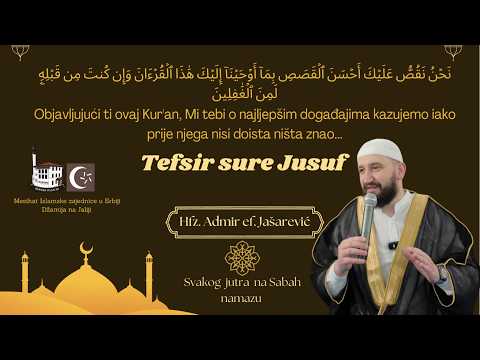
Otkrivanje identiteta (dio 23)
The Revealing of Identity
Automatski transkript (lektorisan)Automatic transcript (proofread)
Automatski transkript. Napravljen je iz zvuka snimka i lektorisan, ali nije provjeren uz slušanje— moguće su greške, naročito u imenima i arapskim citatima. Mjerodavan je video.
Machine translation. Translated from the automatic Bosnian transcript — names and Arabic quotations may be inaccurate. The video is authoritative.
- 0:00
نَحْنُ نَقُصُّ عَلَيْكَ أَحْسَنَ الْقَصَصِ بِمَا أَوْحَيْنَا إِلَيْكَ هَٰذَا الْقُرْآنَ وَإِنْ كُنْتَ مِنْ قَبْلِهِ لَمِنَ الْغَافِلِينَ
„Mi ti kazujemo najljepše kazivanje objavljujući ti ovaj Kur’an, a ti prije njega o tome nisi ništa znao.“ (Jusuf, 3)
- 0:30
Jusuf: nakon što se Jusufova braća vratiše bez Benjamina u Palestinu, Jakub se jako razočara. Razočara se u njih, to ga podsjeti na onu prevaru koju su mu priredili sinovi prije 30 godina, kada su Jusufa bacili u bunar. Pa se odvoji i kaže: „Ja moju tugu i moj jad iznosim samo pred Allaha, subhanehu ve te'ala.“ Nakon toga im naredi, kaže: „Vratite se i tražite haber, vijesti o Jusufu i njegovom bratu. Vratite se u Egipat.“
- 1:16
Pa oni poslušaše oca i vratiše se u Egipat, da traže vijesti, to jest haber o Jusufu i njegovom bratu, i naravno da uzmu hrane, jer ih je baš pogodila ta suša, nisu imali, znači, bukvalno ništa.
- 1:42
قَالُوا يَا أَيُّهَا الْعَزِيزُ مَسَّنَا وَأَهْلَنَا الضُّرُّ وَجِئْنَا بِبِضَاعَةٍ مُزْجَاةٍ فَأَوْفِ لَنَا الْكَيْلَ وَتَصَدَّقْ عَلَيْنَا ۖ إِنَّ اللَّهَ يَجْزِي الْمُتَصَدِّقِينَ
„O vladaru, nas i porodicu našu snašla je nevolja, a donijeli smo malo robe, pa nam podaj punu mjeru i udijeli nam milostinju; Allah, zaista, nagrađuje one koji milostinju dijele.“ (Jusuf, 88)
- 2:10
Ali ne samo nas, nego i naše porodice. Pa nam, kažu, daj hrane, daj nam te tovare u potpunosti, potpunu mjeru. Ne samo to: „ve tesaddek alejna“ – i kažu: daj nam sadaku pored toga.
- 2:32
Jer su bili, znači, to je dno dna, ne može više od toga. „وَتَصَدَّقْ عَلَيْنَا إِنَّ اللَّهَ يَجْزِي الْمُتَصَدِّقِينَ“ – doista Allah, kažu, nagrađuje, nagrađuje one koji udjeljuju, one koji udjeljuju sadaku. Pa vidimo, draga braćo, iz ovog primjera ovdje da ni poslanici nisu bili izostavljeni od iskušenja, i da je ovaj dunjaluk prolazan i da ne vrijedi ništa, što i potvrđuje hadis Poslanika
- 3:12
Muhammeda, sallallahu alejhi ve sellem, gdje kaže: „Lev kanetid-dunja ta'dilu indallahi dženaha be'udatin ma seka kafiren minha šerbete ma'in.“ Kaže: da dunjaluk vrijedi kod Allaha koliko krilo od komarca, od mušice, kaže, ne bi dozvolio kafiru, ne bi dao kap vode da popije. Toliko je dunjaluk kod Allaha vrijedan. Također, kaže Allah, subhanehu ve te'ala: „Ehasiben-nasu en jutraku en jekulu amenna ve hum la juftenun.“ Zar misle, kaže, ljudi
- 3:55
da će, kada izgovore riječi „amenna“ – vjerujemo – biti prepušteni sami sebi, to jest da će lijepo poživjeti bez iskušenja, a, kaže, da neće pritom biti iskušavani? E, draga braćo, čim kažeš „amenna“, vjerujem – iskušenja sa svih strana.
- 4:19
Prvo dolazi od porodice. Pa ako nema porodice, znači imaš sa komšijom; ako nemaš sa komšijom, imaš sa nekim na ulici; ako nemaš sa nekim na ulici, imaš sa nekim u džematu; ako nemaš sa nekim u džematu, imaš sa hanumom, i sve tako, sve u krug.
- 4:34
To je dunjaluk. Ne može čovjek da se spasi toga nikako. Nikako ne može da se spasi toga. Sa druge strane, nikako ne znači, kada vidimo čovjeka da lijepo živi, da uživa u blagodatima, ali nema ga niti u džamiji, niti na nekim vjerskim okupljanjima, nema ga nigdje – nema čovjek da misli da je takav, da ga je Allah nešto uzdigao. Ili, kaže Allah, subhanehu ve te'ala:
- 5:12
وَلَا يَحْسَبَنَّ الَّذِينَ كَفَرُوا أَنَّمَا نُمْلِي لَهُمْ خَيْرٌ لِأَنْفُسِهِمْ
„Neka nikako ne misle oni koji ne vjeruju da je za njih dobro to što im Mi vremena dajemo…“ (Ali Imran, 178)
- 5:16
kaže: i nemoj, kaže, da misle, kaže, oni nevjernici da je ono što im Mi dajemo od dunjaluka, od mnogo dunjaluka, novca, uživanja, putovanja i tako dalje, da je to, kaže, dobro za njih. Kaže: Mi im samo to dajemo kako bi još više propali, još više ogrezli u grijeh. Kaže: njih slijedi ogromna, ogromna patnja. Pa je ovaj dunjaluk prolazan, što nam i dokazuju ovi ajeti.
- 5:53
Nakon što oni iznesoše pred Jusufa – već je stvar došla do usijanja, ne može više, znači toliko ih je pogodila suša, tegoba itd. –
- 6:10
pa se Jusuf smilova. Kaže im Jusuf, kaže: „Kale hel alimtum ma fe'altum bi Jusufe ve ehihi iz entum džahilun“ – kaže: „Znate li“, kaže, „jeste li“, kaže, „svjesni šta ste uradili sa Jusufom“ – „ve ehihi iz entum džahilun“ – „i njegovim bratom, kada ste neznalice bili?“
- 6:35
Pa Jusuf tu ih upita, kaže: „Jeste li“, kaže, „svjesni šta ste uradili sa Jusufom i njegovim bratom, kada ste neznalice bili?“ Pa i ovdje u ovim riječima ih Jusuf opravda, kaže: „bili ste“ – šta? – „neznalice“. Nije rekao „bili ste loši, bili ste [nejasno]“, nego, kaže, „bili ste neznalice“, džahili. Pa oni shvatiše da je to Jusuf.
- 7:05
„Kalu e inneke le ente Jusuf“ – kažu: „Jesi li ti Jusuf? Jesi li ti Jusuf, naš brat?“ „Kale ene Jusufu ve haza ehi“ – kaže: „Ja sam Jusuf, a“, kaže, „pored mene moj brat Benjamin. Kad mennallahu alejna“ – doista je, kaže, doista nas je, kaže, Allah uzdigao, podario nam rahmet, blagodat, blagodat vlasti, ahlaka, imana. „Doista“, kaže, „onaj koji se boji Allaha
- 7:46
i koji sabura“, kaže, „doista Allah“, kaže, „neće dozvoliti“, kaže, „da propadne nagrada onih dobročinitelja.“ Pa je, draga braćo, sabur – to je prvo, bogobojaznost i sabur – to je recept za uspjeh.
- 8:05
To je recept za uspjeh. Šta je bogobojaznost? A to je da čovjek napravi zastor između njega i Allahove kazne, činjenjem onoga što mu je Allah, subhanehu ve te'ala, naredio, i da se kloni onoga što mu je zabranio.
- 8:24
A sabur – govorili smo o saburu, koliko ima vrsta sabura ili strpljenja. Pa je ovo, znači, da čovjek bude bogobojazan i da bude strpljiv, i Allah će dati izlaz: „وَمَنْ يَتَّقِ اللَّهَ يَجْعَلْ لَهُ مَخْرَجًا“ – i doista, kaže, onome ko se bude Allaha bojao, kaže, Allah će mu dati izlaz iz svake, iz svake situacije.
- 8:51
Kažu dalje njegova braća Jusufu: „قَالُوا تَاللَّهِ لَقَدْ آثَرَكَ اللَّهُ عَلَيْنَا وَإِنْ كُنَّا لَخَاطِئِينَ“ – kažu: „Doista“, kažu, „Allah te odlikovao iznad, nad nama
- 9:09
vlašću, bogobojaznošću, znanjem, a“, kažu, „mi smo, mi smo pogriješili sa tobom, a mi smo pogriješili sa tobom.“ Pa od znakova tevbe ili pokajanja jeste da čovjek prvo prizna grešku, da se pokaje, da prizna grešku i da prizna da nije bio u pravu, što su uradila Jusufova braća. Šta im kaza Jusuf? Je li krenuo Jusuf da im govori: „Pa vi ste uradili [nejasno]“? Nije.
- 9:47
Pa da vidite kakav ahlak Jusufa! Kaže, kaže, kaže: „La tesribe alejkumul-jevm“ – kaže: neću vam danas [nejasno], neću vas koriti. Gotovo, Jusuf im je oprostio. Kaže: „La tesribe alejkumul-jevm.
- 10:03
Jagfirullahu lekum“ – kaže: Allah vam i oprostio – „ve huve erhamur-rahimin“ – doista je, kaže, On najmilostiviji. I vidimo koliko Jusuf… Gledajte, draga braćo, ove priče koje nam Allah, subhanehu ve te'ala, priča u Kur'anu – ovo nije samo da bismo mi slušali i izašli iz ove džamije, a da ništa od toga ne primijenimo.
- 10:26
Nego, zbog čega nam je ovo Allah, subhanehu ve te'ala, preko Poslanika poslao, ove priče? Pa da bismo uzeli pouku. Da bismo se mi okitili ovim ponašanjem, ovim lijepim osobinama. Pa kada neko dođe, neki brat koji je pogriješio prema nama, i kaže: „Halali, brate, ja sam pogriješio“,
- 10:50
ne treba čovjek da kaže i da mu ređa i tako dalje, nego treba da postupi kao što je postupio Jusuf, da kaže: „Halal ti je.“ Šta je vrhunac bio ovdje? Vrhunac je to što im Jusuf ne samo da je halalio, nego je dovio za njih.
- 11:09
Dovio je Allahu, subhanehu ve te'ala, da im oprosti grijehe: „La tesribe alejkumul-jevm. Jagfirullahu lekum ve huve erhamur-rahimin.“ Šta im kaže dalje Jusuf? Pošto je Jusuf [nejasno] da je Jakub oslijepio,
- 11:28
kaže: „Izhebu bi kamisi haza fe elkuhu ala vedžhi ebi je'ti besira“ – kaže: „Uzmite ovu košulju, moju košulju, na kojoj je moj miris, otiđite i“, kaže, „stavite na lice moga oca.“ Kaže: „Vratit će mu se vid.“
- 11:46
Vratit će mu se vid. Neki kažu da je ova košulja bila Ibrahimova, pa je naslijedio Ishak, pa od Ishaka Jakub, pa je Jakub na kraju dao Jusufu.
- 12:01
Šta kaže dalje? „Elkuhu ala vedžhi ebi je'ti besira, ve'tuni bi ehlikum edžmein.“ I kada se sve završi, pokupite, kaže, cijelu vašu porodicu i dođite u Egipat. Evo ga odgovor na ono pitanje: kako su Jevreji dospjeli u Egipat?
- 12:20
Evo je put, znači, Jusuf ih je doveo u Egipat. Pa se onda mijenjalo vrijeme, mijenjali se vladari, onda je došao onaj poznati faraon za vrijeme Musaa i onda odatle kreće povratak u Palestinu.
- 12:36
I kada krenu karavane nazad u Palestinu, šta kaže Jakub? Kaže: „Osjećam“, kaže, „miris Jusufa, alejhis-salatu ves-selam.“
- 12:59
Osjeća miris Jusufa, alejhis-selam. Zamisli, znači, osam dana pješačenja – on osjeća miris Jusufa. „Inni le edžidu riha Jusufe lev la en tufennidun“ – kaže: „A znam“, kaže, „da ćete reći da sam lud, da nisam dobro.“ Šta mu kažu oni koji su bili oko njega? Njegovi sinovi – njegovi sinovi su u karavanu. „Kalu tallahi inneke lefi dalalikel-kadim“ – kažu: „Doista si ti“, kažu, „Jakube, u onoj staroj zabludi“ – znači, zaslijepljen si
- 13:39
ljubavlju prema Jusufu i željom za njim itd. Pa ćete vidjeti, inšaAllah, sutra, kada budemo govorili – sutra ćemo da završimo sa tefsirom sure Jusuf i ostat će još jedan mali dio koji je upućen našem Poslaniku Muhammedu – vidjet ćete kada se oni budu izvinjavali Jakubu, kada dođe ova košulja i dođe sve ovo, pa će oni da traže halal, traže oprost, da im Jakub moli za oprost kod Allaha, subhanehu ve te'ala. Sve ovo, draga braćo, ovo je prelijepa priča koja je puna pouka i poruka do
- 14:20
kraja ovoga, ovoga dunjaluka. Pa čovjek… to, ovo nije samo sura Jusuf, cijeli Kur'an je ovakav. Zato čovjek treba da razmišlja o Kur'anu, kako nas o tome i uči Allah, subhanehu ve te'ala, kaže: zar ne razmišljaju o Kur'anu? Nije Kur'an da se vidi na ovim policama, da ga umotamo u neku čevrmu, neku mahramu kod kuće i onda stavimo na policu, nego je Kur'an da čovjek razmišlja, da uživa u njegovim poukama, porukama. Za to je Kur'an objavljen, objavljen čovječanstvu. Molim Allaha, subhanehu ve te'ala, da vas nagradi svakim dobrom.
- 15:01
Molim Njega Uzvišenog da nam pomogne da ispostimo i ovo što je ostalo od mjeseca. Molim Njega Uzvišenog da smo dosegli noć Lejletul-kadra. Molim Njega Uzvišenog da nam oprosti grijehe, grijehe naših roditelja, da nas uvede u Džennet. Amin, ja Rabbel-alemin. Es-selamu alejkum ve rahmetullah.
- 0:00
نَحْنُ نَقُصُّ عَلَيْكَ أَحْسَنَ الْقَصَصِ بِمَا أَوْحَيْنَا إِلَيْكَ هَٰذَا الْقُرْآنَ وَإِنْ كُنْتَ مِنْ قَبْلِهِ لَمِنَ الْغَافِلِينَ
“We relate to you the best of stories in revealing to you this Qur’an, though before it you were among the unaware.” (Yusuf 12:3)
- 0:30
Yusuf: after Yusuf's brothers returned to Palestine without Benjamin, Ya'qub was deeply disappointed. He was disappointed in them; it reminded him of the deception his sons had played on him 30 years earlier, when they threw Yusuf into the well. So he withdrew and said: "I complain of my grief and my sorrow only to Allah, subhanahu wa ta'ala." After that he commanded them, saying: "Go back and seek tidings, news of Yusuf and his brother. Go back to Egypt."
- 1:16
So they obeyed their father and returned to Egypt, to seek news, that is, tidings of Yusuf and his brother, and of course to obtain food, because that drought had hit them hard; they had, that is, literally nothing.
- 1:42
قَالُوا يَا أَيُّهَا الْعَزِيزُ مَسَّنَا وَأَهْلَنَا الضُّرُّ وَجِئْنَا بِبِضَاعَةٍ مُزْجَاةٍ فَأَوْفِ لَنَا الْكَيْلَ وَتَصَدَّقْ عَلَيْنَا ۖ إِنَّ اللَّهَ يَجْزِي الْمُتَصَدِّقِينَ
“O ‘Aziz, hardship has touched us and our family, and we have come with goods of little value; so give us full measure and be charitable to us. Indeed, Allah rewards the charitable.” (Yusuf 12:88)
- 2:10
And not only us, but our families as well. So, they say, give us food, give us these loads in full, full measure. And not only that: "wa tasaddaq 'alayna" – they say: and give us charity on top of that.
- 2:32
Because they were, that is, at rock bottom; it could not get any worse than that. "وَتَصَدَّقْ عَلَيْنَا إِنَّ اللَّهَ يَجْزِي الْمُتَصَدِّقِينَ" – truly Allah, they say, rewards, rewards those who give charity, those who give sadaqa. So we see, dear brothers, from this example here that not even the prophets were spared trials, and that this world is passing and worth nothing, which is confirmed by the hadith of the Prophet
- 3:12
Muhammad, sallallahu alayhi wa sallam (peace be upon him), where he says: "Law kanatid-dunya ta'dilu 'indallahi janaha ba'udatin ma saqa kafiran minha sharbata ma'." He says: if this world were worth to Allah as much as the wing of a mosquito, of a gnat, He would not allow an unbeliever, would not give him a drop of water to drink. That is how much this world is worth to Allah. Also, Allah, subhanahu wa ta'ala, says: "Ahasiban-nasu an yutraku an yaqulu amanna wa hum la yuftanun." Do people think, He says,
- 3:55
that when they utter the words "amanna" – we believe – they will be left to themselves, that is, that they will live nicely without trials, and, He says, that they will not be tested in the process? Well, dear brothers, as soon as you say "amanna," I believe – trials from every side.
- 4:19
First it comes from the family. And if not from the family, then you have it with your neighbour; if not with your neighbour, you have it with someone in the street; if not with someone in the street, you have it with someone in the congregation; if not with someone in the congregation, you have it with your wife, and so on, all around in a circle.
- 4:34
That is this world. A person cannot escape it in any way. He cannot escape it in any way. On the other hand, it in no way means – when we see a man living well, enjoying blessings, but he is not at the mosque, nor at any religious gatherings, he is nowhere to be seen – that a person should think that because he is like that, Allah has somehow raised him up. Or, as Allah, subhanahu wa ta'ala, says:
- 5:12
وَلَا يَحْسَبَنَّ الَّذِينَ كَفَرُوا أَنَّمَا نُمْلِي لَهُمْ خَيْرٌ لِأَنْفُسِهِمْ
“And let not those who disbelieve think that Our giving them respite is good for them…” (Al Imran 3:178)
- 5:16
He says: and let not, He says, those unbelievers think that what We give them of this world, of a great deal of this world, money, pleasure, travel and so on, that this, He says, is good for them. He says: We only give them this so that they may be ruined even more, sink even deeper into sin. He says: a huge, huge torment awaits them. So this world is passing, as these ayat prove to us.
- 5:53
After they laid it all out before Yusuf – things had already come to a boiling point, it could not go on, that is, the drought, the hardship and so on had struck them so badly –
- 6:10
Yusuf took pity on them. Yusuf said to them: "Qala hal 'alimtum ma fa'altum bi Yusufa wa akhihi idh antum jahilun" – he says: "Do you know," he says, "are you," he says, "aware of what you did to Yusuf" – "wa akhihi idh antum jahilun" – "and to his brother, when you were ignorant?"
- 6:35
So Yusuf asked them there: "Are you," he says, "aware of what you did to Yusuf and his brother, when you were ignorant?" And even here, in these words, Yusuf excused them, saying: "you were" – what? – "ignorant." He did not say "you were bad, you were [unclear]," but rather, he says, "you were ignorant," jahils. And then they realised that it was Yusuf.
- 7:05
"Qalu a'innaka la-anta Yusuf" – they say: "Are you Yusuf? Are you Yusuf, our brother?" "Qala ana Yusufu wa hadha akhi" – he says: "I am Yusuf, and," he says, "beside me is my brother Benjamin. Qad mannallahu 'alayna" – truly, he says, truly Allah has raised us up, He says, granted us mercy, blessing, the blessing of authority, of good character, of iman. "Truly," he says, "whoever fears Allah
- 7:46
and is patient," he says, "truly Allah," he says, "will not allow," he says, "the reward of those who do good to be lost." So, dear brothers, sabr – that is first, God-consciousness and sabr (patience) – that is the recipe for success.
- 8:05
That is the recipe for success. What is God-consciousness? It is that a person places a barrier between himself and Allah's punishment, by doing what Allah, subhanahu wa ta'ala, has commanded him and by keeping away from what He has forbidden him.
- 8:24
And sabr – we have spoken about sabr, about how many kinds of sabr, or patience, there are. So this, then, is for a person to be God-conscious and to be patient, and Allah will provide a way out: "وَمَنْ يَتَّقِ اللَّهَ يَجْعَلْ لَهُ مَخْرَجًا" – and truly, He says, whoever fears Allah, He says, Allah will give him a way out of every, every situation.
- 8:51
His brothers further say to Yusuf: "قَالُوا تَاللَّهِ لَقَدْ آثَرَكَ اللَّهُ عَلَيْنَا وَإِنْ كُنَّا لَخَاطِئِينَ" – they say: "Truly," they say, "Allah has favoured you above, over us
- 9:09
in authority, in God-consciousness, in knowledge, and," they say, "we, we have wronged you, we have wronged you." And among the signs of tawbah, or repentance, is that a person first admits his mistake, repents, admits his mistake and admits that he was not right, which is what Yusuf's brothers did. What did Yusuf say to them? Did Yusuf start telling them: "Well, you did [unclear]"? He did not.
- 9:47
Just look at Yusuf's character! He says, he says, he says: "La tathriba 'alaykumul-yawm" – he says: I will not [unclear] you today, I will not reproach you. That is it; Yusuf forgave them. He says: "La tathriba 'alaykumul-yawm.
- 10:03
Yaghfirullahu lakum" – he says: and may Allah forgive you – "wa huwa arhamur-rahimin" – truly, he says, He is the Most Merciful of the merciful. And we see how much Yusuf… Look, dear brothers, these stories that Allah, subhanahu wa ta'ala, tells us in the Qur'an – this is not just so that we listen and walk out of this mosque without applying any of it.
- 10:26
Rather, why did Allah, subhanahu wa ta'ala, send these stories to us through the Prophet? So that we would take a lesson. So that we would adorn ourselves with this behaviour, these beautiful qualities. So when someone comes, some brother who has wronged us, and says: "Forgive me, brother, I was wrong,"
- 10:50
a person should not go on and list everything to him and so on; rather, he should act as Yusuf acted and say: "You are forgiven." What was the peak here? The peak is that Yusuf not only forgave them, but also made dua for them.
- 11:09
He made dua to Allah, subhanahu wa ta'ala, to forgive their sins: "La tathriba 'alaykumul-yawm. Yaghfirullahu lakum wa huwa arhamur-rahimin." What does Yusuf say to them next? Since Yusuf [unclear] that Ya'qub had gone blind,
- 11:28
he says: "Idhhabu bi qamisi hadha fa alquhu 'ala wajhi abi ya'ti basira" – he says: "Take this shirt, my shirt, which carries my scent, go and," he says, "lay it over my father's face." He says: "His sight will return to him."
- 11:46
His sight will return to him. Some say that this shirt belonged to Ibrahim, then Ishaq inherited it, then from Ishaq it passed to Ya'qub, and Ya'qub finally gave it to Yusuf.
- 12:01
What does he say next? "Alquhu 'ala wajhi abi ya'ti basira, wa'tuni bi ahlikum ajma'in." And when it is all over, gather, he says, your whole family and come to Egypt. Here is the answer to that question: how did the Jews end up in Egypt?
- 12:20
Here is the way, that is, Yusuf brought them to Egypt. And then the times changed, the rulers changed, and then came that well-known Pharaoh in the time of Musa, and from there the return to Palestine begins.
- 12:36
And when the caravans set off back to Palestine, what does Ya'qub say? He says: "I sense," he says, "the scent of Yusuf, alayhis-salatu was-salam."
- 12:59
He senses the scent of Yusuf, alayhis-salam. Imagine, that is, eight days' journey on foot – and he senses the scent of Yusuf. "Inni la-ajidu riha Yusufa law la an tufannidun" – he says: "And I know," he says, "that you will say I am mad, that I am not well." What do those who were around him say to him? His sons – his sons are in the caravan. "Qalu tallahi innaka lafi dalalikal-qadim" – they say: "Truly you are," they say, "O Ya'qub, in your old error" – that is, you are blinded
- 13:39
by love for Yusuf and longing for him, and so on. And you will see, in sha Allah, tomorrow, when we speak – tomorrow we will finish the tafsir of Surah Yusuf, and there will still remain one small part that is addressed to our Prophet Muhammad – you will see when they apologise to Ya'qub, when this shirt arrives and all this happens, and they ask to be forgiven, seek forgiveness, ask Ya'qub to pray to Allah, subhanahu wa ta'ala, for their forgiveness. All of this, dear brothers, is a beautiful story full of lessons and messages until
- 14:20
the end of this, this world. So a person… this, this is not only Surah Yusuf; the whole Qur'an is like this. That is why a person should reflect on the Qur'an, as Allah, subhanahu wa ta'ala, teaches us, saying: do they not reflect on the Qur'an? The Qur'an is not there to be seen on these shelves, for us to wrap it in some embroidered cloth, some kerchief at home and then put it on the shelf; rather, the Qur'an is there for a person to reflect on it, to delight in its lessons and messages. That is why the Qur'an was revealed, revealed to mankind. I ask Allah, subhanahu wa ta'ala, to reward you with every good.
- 15:01
I ask Him, the Exalted, to help us complete the fast for what remains of this month. I ask Him, the Exalted, that we may have reached Laylat al-Qadr (the Night of Power). I ask Him, the Exalted, to forgive our sins and the sins of our parents, and to admit us into Jannah (Paradise). Amin, ya Rabbal-'alamin. As-salamu alaykum wa rahmatullah.
Model: large-v3-turbo · generisano 25. 10. 2026.. Uočili ste grešku? Javite nam preko stranice za kontakt.Speech recognition: large-v3-turbo. Spotted an error? Let us know via the contact page.