Ljubomora Jusufove braće (dio 4)
The Jealousy of Yusuf's Brothers
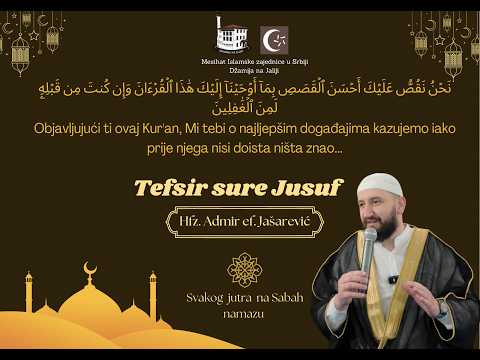
Automatski transkript (lektorisan)Automatic transcript (proofread)
Automatski transkript. Napravljen je iz zvuka snimka i lektorisan, ali nije provjeren uz slušanje— moguće su greške, naročito u imenima i arapskim citatima. Mjerodavan je video.
Machine translation. Translated from the automatic Bosnian transcript — names and Arabic quotations may be inaccurate. The video is authoritative.
- 0:00
نَحْنُ نَقُصُّ عَلَيْكَ أَحْسَنَ الْقَصَصِ بِمَا أَوْحَيْنَا إِلَيْكَ هَٰذَا الْقُرْآنَ وَإِنْ كُنْتَ مِنْ قَبْلِهِ لَمِنَ الْغَافِلِينَ
„Mi ti kazujemo najljepše kazivanje objavljujući ti ovaj Kur’an, a ti prije njega o tome nisi ništa znao.“ (Jusuf, 3)
- 0:20
الْحَمْدُ لِلَّهِ رَبِّ الْعَالَمِينَ وَالصَّلَاةُ وَالسَّلَامُ عَلَى نَبِيِّنَا مُحَمَّدٍ وَعَلَى آلِهِ وَصَحْبِهِ أَجْمَعِينَ
Hvala Allahu, Gospodaru svjetova, a salavat i selam na našeg Vjerovjesnika Muhammeda i na njegovu porodicu i sve njegove ashabe.
- 0:28
Nakon što nas je Allah, subhanehu ve te'ala, obavijestio, na početku sure Jusuf, o snu Jusufa, alejhis-selam, i savjetu njegovog oca,
- 0:45
polako nas uvodi u samu priču Jusufa, alejhis-selam, i njegove braće, rekavši: „Lekad kane fi Jusufe ve ihvetihi ajatun lis-sailin“ – doista je, kaže, u kazivanju o Jusufu, alejhis-salatu ves-selam, i njegovoj braći ibret, pouka i znaci Allahove moći da mijenja stanje čovjeka kako On hoće.
- 1:33
Doista su to znaci i pouka za one koji pitaju, koji traže znanje. Pa je sura, ili priča o Jusufu, alejhis-salatu ves-selam, puna, draga braćo, pouka i poruka.
- 1:51
Vidjet ćete, ako Bog da: puna pouka i poruka. Nije samo da čovjek sluša tu priču, već da se okoristi, da sluša tu priču i da popravi samoga sebe na bolje. Kaže dalje Allah, subhanehu ve te'ala: „Iz kalu le Jusufu ve ehuhu ehabbu ila ebina minna“ – kada rekoše Jusufova braća: „Jusuf i njegov brat Benjamin su draži našem ocu Jakubu od nas.“
- 2:40
Da li je Jakub stvarno volio Jusufa i Benjamina više od njegove braće, i šta je dovelo do ovakvog razmišljanja, draga braćo?
- 2:59
Šta je navelo Jusufovu braću da ovako razmišljaju? Učenjaci navode nekoliko razloga. Prvi razlog, kako kažu učenjaci: da su Jusuf i njegov brat Benjamin, kažu, bili mali.
- 3:18
Da su bili mali, a njihova braća starija od njih, veća. Pa se, kažu, Jakub posebno brinuo o njima. Što je i normalno: svi imamo stariju, imamo i mlađu djecu, pa se čovjek više brine o onom malom djetetu, jer je ono u potrebi.
- 3:43
Uvijek mora da je jedan roditelj kod njega, ne može nikako da ga ostavi samog. Pa onom starijem djetetu nekad se čini da ga roditelj zapostavlja, a nije tako, već je zaokupljen oko ovog manjeg djeteta.
- 4:06
Druga stvar, kako kažu učenjaci, jeste, kažu, da je Jusufova i Benjaminova majka Rahila preselila. A Jakub, alejhis-selam, kažu, je imao četiri žene.
- 4:22
Od jedne je imao šest sinova, a od ove tri po dva. Pa je Jusufova i Benjaminova majka preselila. Pa je, kažu, htio Jakub da nadomjesti to odsustvo njihove majke, pa se što više brinuo o njima.
- 4:42
I zato se, ovaj, javio taj osjećaj kod ove njegove braće. Treća stvar, kako navode učenjaci, jeste: kada je Jakub, alejhis-selam, vidio ovaj san,
- 5:00
to jest kada mu je Jusuf ispričao san, on je bio siguran da će Jusuf, alejhis-selam, biti poslanik, da će ga Allah poslati kao poslanika, pa se više brinuo o njemu, da mu neko ne naškodi i tako, i tako dalje.
- 5:16
I četvrta stvar, kako kažu: da je Jakub stvarno volio Jusufa. Zbog čega? Kažu: jer je Jusuf bio lijepog ahlaka, bio je, kažu, poslušan, marljiv, zbog toga ga je volio više. Ali ovo nikako ne znači da je Jakub, alejhis-selam, bio nepravedan prema svojoj djeci.
- 5:40
Nikako ne bi jedan vjernik smio da pomisli da je Jakub bio nepravedan, jer je Jakub jedan od najboljih Allahovih poslanika.
- 5:51
Jednostavno, osjećanja su, draga braćo, nešto čime čovjek ne može da vlada, tim stvarima. Jednostavno, čovjek nekog voli više, nekog manje, ali je bitno da čovjek bude pravedan.
- 6:07
Pa kada je upitan Poslanik Muhammed, sallallahu alejhi ve sellem, od strane Amra ibn Asa, kaže: „Ko ti je, Poslaniče, najdraži? Ko ti je najdraži?“ Kaže: „Najdraža mi je Aiša“ – najviše volim Aišu, moju suprugu.
- 6:23
Je li Poslanik, sallallahu alejhi ve sellem, imao više supruga? Jeste. Ovo nikako ne znači da je Poslanik, sallallahu alejhi ve sellem, bio nepravedan prema ostalim suprugama, već, jednostavno, to su osjećanja. Čovjek ne može da vlada svojim osjećanjima, ali može da vlada svojim ponašanjem:
- 6:43
hoće li biti pravedan ili neće biti. Kažu dalje Jusufova braća, kažu: kako je Jusuf draži, i njegov brat, našem ocu od nas?
- 7:03
„A“, kažu, „mi smo jedna velika grupa, nas desetorica, naš otac je u potrebi za nama, pa mu mi pomažemo u poslovima“ i tako, i tako dalje. „Kako može da više voli Jusufa i njegovog brata, koji nisu od neke koristi? Doista je“, kažu, „naš otac u velikoj zabludi.“ Vidite dokle ide ova ljubomora, ova zavist: da optužuju Božijeg poslanika
- 7:45
da je u zabludi. Pa ništa novo: svi poslanici su bili optuživani da su u zabludi. Pa je naš Poslanik, sallallahu alejhi ve sellem, bio optuživan da je ludak, da je pjesnik i tako, i tako – ništa novo. Ali je ovdje ibret i pouka u ovoj ljubomori i zavisti, draga braćo. Zavist je bolest. Kaže Poslanik Muhammed, sallallahu alejhi ve sellem: „El-hasedu je'kulul-hasenati kema te'kulun-narul-hatab.“ Doista
- 8:25
zavist uništava dobra djela – doista zavist, ljubomora uništava dobra djela – kao što vatra uništava drvo, to jest spaljuje dobra djela. Pa kada govore o zavisti, učenjaci navode, to jest Ibn Kajjim navodi, tri vrste zavisti. Prva zavist jeste da čovjek ima zavist, ali je krije i ne želi da ona pređe na svoga brata, to jest na njegovog brata, njegovog komšiju, niti srcem, niti jezikom, niti djelom,
- 9:15
već je čovjek suzbija i ponaša se prema svome bratu onako kako Allah, subhanehu ve te'ala, voli. To jest, ne smije da mu – iako ima zavist – ne smije svome bratu da čini nepravdu. Druga pak vrsta jeste stvarno bolest.
- 9:35
Jeste da čovjek toliko zavidi svome bratu muslimanu da ne želi da mu Allah da bilo koju blagodat, to jest želi da ona blagodat koja je kod njegovog brata nestane, da je nema. I ova je najgora vrsta: da čovjek, kada vidi kod brata muslimana da ima dobru kuću, da ima dobru porodicu, dobro auto, želi da to nestane, da mu to Allah, subhanehu ve te'ala, oduzme. Zato su, draga braćo, mnogo bitne sure „Kul e'uzu bi Rabbil-felek“,
- 10:16
قُلْ أَعُوذُ بِرَبِّ النَّاسِ
„Reci: ‘Utječem se Gospodaru ljudi…’“ (En-Nas, 1)
- 10:17
قُلْ أَعُوذُ بِرَبِّ الْفَلَقِ مِنْ شَرِّ مَا خَلَقَ وَمِنْ شَرِّ غَاسِقٍ إِذَا وَقَبَ وَمِنْ شَرِّ النَّفَّاثَاتِ فِي الْعُقَدِ وَمِنْ شَرِّ حَاسِدٍ إِذَا حَسَدَ
„Reci: ‘Utječem se Gospodaru svitanja od zla onoga što On stvara, i od zla mrkle noći kada se razlije, i od zla onih koje pušu u čvorove, i od zla zavidnika kada zavidi.’“ (El-Felek, 1–5)
Arapski tekst je automatski prepoznat — nije još provjeren.
- 10:50
„I od zla sihirbazica koje pušu u čvorove. I od šerra, zla zavidnika“ – ali ne bilo kojeg zavidnika.
- 11:08
Eto kako je Kur'an precizan: „I od šerra, zla zavidnika koji zavidi.“ Pa imate zavidnika – kao što smo rekli, prva vrsta – zavidan čovjek, ali ne želi da to pređe na njegovog brata muslimana, već suzbija tu svoju zavist, tu ljubomoru.
- 11:33
Ali najgori je onaj koji zavidi, koji želi da njegov brat, njegov komšija bude uništen. Pa je to, to je, draga braćo, bolest. Čovjek treba ovu suru stalno, stalno da ponavlja, ne bi li ga Allah, subhanehu ve te'ala, sačuvao, sačuvao takvih ljudi, takvih bolesnika.
- 11:55
Za danas toliko, pa ćemo, inšaAllahu te'ala, sutra, sutra nastaviti. Allah vam dao svako dobro.
- 0:00
نَحْنُ نَقُصُّ عَلَيْكَ أَحْسَنَ الْقَصَصِ بِمَا أَوْحَيْنَا إِلَيْكَ هَٰذَا الْقُرْآنَ وَإِنْ كُنْتَ مِنْ قَبْلِهِ لَمِنَ الْغَافِلِينَ
“We relate to you the best of stories in revealing to you this Qur’an, though before it you were among the unaware.” (Yusuf 12:3)
- 0:20
الْحَمْدُ لِلَّهِ رَبِّ الْعَالَمِينَ وَالصَّلَاةُ وَالسَّلَامُ عَلَى نَبِيِّنَا مُحَمَّدٍ وَعَلَى آلِهِ وَصَحْبِهِ أَجْمَعِينَ
Praise be to Allah, Lord of the worlds, and blessings and peace be upon our Prophet Muhammad and upon his family and all his companions.
- 0:28
After Allah, subhanahu wa ta'ala, informed us, at the beginning of Surah Yusuf, about the dream of Yusuf, alayhis-salam (peace be upon him), and his father's advice,
- 0:45
He gradually leads us into the story itself of Yusuf, alayhis-salam, and his brothers, saying: "Laqad kana fi Yusufa wa ikhwatihi ayatun lis-sa'ilin" – truly, He says, in the account of Yusuf, alayhis-salatu was-salam, and his brothers there is a lesson, a teaching, and signs of Allah's power to change a person's state as He wills.
- 1:33
Truly, these are signs and a lesson for those who ask, who seek knowledge. And so the surah, or the story of Yusuf, alayhis-salatu was-salam, is full, dear brothers, of lessons and messages.
- 1:51
You will see, in sha Allah: full of lessons and messages. It is not just that a person listens to this story; rather, he should benefit from it, listen to this story and improve himself for the better. Allah, subhanahu wa ta'ala, further says: "Idh qalu la-Yusufu wa akhuhu ahabbu ila abina minna" – when Yusuf's brothers said: "Yusuf and his brother Benjamin are dearer to our father Ya'qub than we are."
- 2:40
Did Ya'qub really love Yusuf and Benjamin more than their brothers, and what led to this kind of thinking, dear brothers?
- 2:59
What led Yusuf's brothers to think this way? The scholars mention several reasons. The first reason, as the scholars say, is that Yusuf and his brother Benjamin, they say, were small.
- 3:18
That they were small, while their brothers were older and bigger than them. So, they say, Ya'qub took special care of them. Which is only natural: we all have older children and younger children, and a person cares more for the little child, because it is in need.
- 3:43
One parent always has to be with it; he simply cannot leave it alone. And so the older child sometimes feels that the parent is neglecting him, but that is not so; rather, the parent is preoccupied with the younger child.
- 4:06
The second thing, as the scholars say, is, they say, that the mother of Yusuf and Benjamin, Rahil (Rachel), had passed away. And Ya'qub, alayhis-salam, they say, had four wives.
- 4:22
From one he had six sons, and from these other three, two each. And the mother of Yusuf and Benjamin had passed away. So, they say, Ya'qub wanted to make up for the absence of their mother, and he cared for them all the more.
- 4:42
And that is why, well, this feeling arose in these brothers of his. The third thing, as the scholars mention, is this: when Ya'qub, alayhis-salam, saw this dream,
- 5:00
that is, when Yusuf told him the dream, he was certain that Yusuf, alayhis-salam, would be a prophet, that Allah would send him as a prophet, so he took more care of him, so that no one would harm him, and so on, and so forth.
- 5:16
And the fourth thing, as they say: that Ya'qub truly loved Yusuf. Why? They say: because Yusuf had beautiful character; he was, they say, obedient and diligent, and that is why he loved him more. But this in no way means that Ya'qub, alayhis-salam, was unjust towards his children.
- 5:40
A believer must never think that Ya'qub was unjust, because Ya'qub is one of the best of Allah's prophets.
- 5:51
Simply put, dear brothers, feelings are something a person cannot control, those things. Simply, a person loves one more and another less, but what matters is that a person is just.
- 6:07
So when the Prophet Muhammad, sallallahu alayhi wa sallam (peace be upon him), was asked by Amr ibn al-As: "Who is dearest to you, O Messenger? Who is dearest to you?" he said: "Aisha is dearest to me" – I love Aisha, my wife, the most.
- 6:23
Did the Prophet, sallallahu alayhi wa sallam, have more than one wife? He did. This in no way means that the Prophet, sallallahu alayhi wa sallam, was unjust towards his other wives; rather, simply, these are feelings. A person cannot control his feelings, but he can control his behaviour:
- 6:43
whether he will be just or not. Yusuf's brothers further say: how is it that Yusuf and his brother are dearer to our father than we are?
- 7:03
"Yet," they say, "we are a large group, the ten of us; our father needs us, and we help him with the work," and so on, and so forth. "How can he love Yusuf and his brother more, when they are of no particular use? Truly," they say, "our father is in great error." You see how far this jealousy, this envy goes: that they accuse a prophet of Allah
- 7:45
of being in error. Well, nothing new: all the prophets were accused of being in error. Our Prophet, sallallahu alayhi wa sallam, was accused of being a madman, of being a poet, and so on and so forth – nothing new. But here there is a lesson and a teaching in this jealousy and envy, dear brothers. Envy is a disease. The Prophet Muhammad, sallallahu alayhi wa sallam, says: "Al-hasadu ya'kulul-hasanati kama ta'kulun-narul-hatab." Truly,
- 8:25
envy destroys good deeds – truly envy, jealousy destroys good deeds – just as fire destroys wood, that is, it burns up good deeds. And when speaking about envy, the scholars mention, that is, Ibn al-Qayyim mentions, three kinds of envy. The first kind is when a person has envy but hides it and does not want it to reach his brother, that is, his brother, his neighbour, neither with his heart, nor with his tongue, nor with his deeds,
- 9:15
but rather the person suppresses it and behaves towards his brother as Allah, subhanahu wa ta'ala, loves. That is, he must not – even though he has envy – he must not wrong his brother. The second kind, however, is truly a disease.
- 9:35
It is when a person envies his Muslim brother so much that he does not want Allah to give him any blessing at all, that is, he wants the blessing his brother has to disappear, to be gone. And this is the worst kind: when a person sees that his Muslim brother has a good house, a good family, a good car, and he wants it to disappear, wants Allah, subhanahu wa ta'ala, to take it away from him. That is why, dear brothers, the surahs "Qul a'udhu bi Rabbil-falaq"
- 10:16
قُلْ أَعُوذُ بِرَبِّ النَّاسِ
“Say, ‘I seek refuge in the Lord of mankind…’” (An-Nas 114:1)
- 10:17
قُلْ أَعُوذُ بِرَبِّ الْفَلَقِ مِنْ شَرِّ مَا خَلَقَ وَمِنْ شَرِّ غَاسِقٍ إِذَا وَقَبَ وَمِنْ شَرِّ النَّفَّاثَاتِ فِي الْعُقَدِ وَمِنْ شَرِّ حَاسِدٍ إِذَا حَسَدَ
“Say, ‘I seek refuge in the Lord of daybreak from the evil of what He has created, and from the evil of darkness when it settles, and from the evil of those who blow on knots, and from the evil of an envier when he envies.’” (Al-Falaq 113:1–5)
Arabic text recognised automatically — not yet verified.
- 10:50
"And from the evil of the witches who blow on knots. And from the evil of the envier" – but not just any envier.
- 11:08
See how precise the Qur'an is: "And from the evil of the envier when he envies." So you have the envier – as we said, the first kind – an envious person who does not want it to reach his Muslim brother, but suppresses his envy, his jealousy.
- 11:33
But the worst is the one who envies and wants his brother, his neighbour, to be ruined. And that, that is, dear brothers, a disease. A person should constantly, constantly repeat this surah, so that Allah, subhanahu wa ta'ala, may protect him, protect him from such people, from such sick people.
- 11:55
That is all for today, and in sha Allahu ta'ala we will continue tomorrow, tomorrow. May Allah grant you every good.
Model: large-v3-turbo · generisano 25. 10. 2026.. Uočili ste grešku? Javite nam preko stranice za kontakt.Speech recognition: large-v3-turbo. Spotted an error? Let us know via the contact page.