Kraljev san (dio 15)
The King's Dream
Automatski transkript (lektorisan)Automatic transcript (proofread)
Automatski transkript. Napravljen je iz zvuka snimka i lektorisan, ali nije provjeren uz slušanje— moguće su greške, naročito u imenima i arapskim citatima. Mjerodavan je video.
Machine translation. Translated from the automatic Bosnian transcript — names and Arabic quotations may be inaccurate. The video is authoritative.
- 0:00
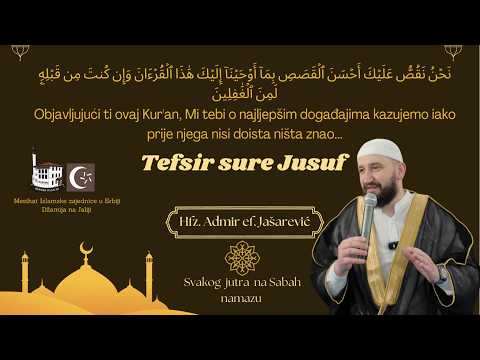
نَحْنُ نَقُصُّ عَلَيْكَ أَحْسَنَ الْقَصَصِ بِمَا أَوْحَيْنَا إِلَيْكَ هَٰذَا الْقُرْآنَ وَإِنْ كُنْتَ مِنْ قَبْلِهِ لَمِنَ الْغَافِلِينَ
„Mi ti kazujemo najljepše kazivanje objavljujući ti ovaj Kur’an, a ti prije njega o tome nisi ništa znao.“ (Jusuf, 3)
- 0:20
الْحَمْدُ لِلَّهِ رَبِّ الْعَالَمِينَ وَالصَّلَاةُ وَالسَّلَامُ عَلَى نَبِيِّنَا مُحَمَّدٍ وَعَلَى آلِهِ وَصَحْبِهِ أَجْمَعِينَ
Hvala Allahu, Gospodaru svjetova, a salavat i selam na našeg Vjerovjesnika Muhammeda i na njegovu porodicu i sve njegove ashabe.
- 0:27
Nastavljamo sa tefsirom sure Jusuf. Nakon što Jusuf protumači snove ovim mladićima
- 0:40
koji su bili zajedno sa njim u zatvoru, obrati se onom mladiću za kojeg je sigurno znao da će da se vrati na dvor, da bude vinotoča kralju, pa mu reče, kaže: „Spomeni me kod kralja: ima ovdje u zatvoru ovom mazlum, onaj kome je nepravda učinjena, pa me spomeni.“ Pa kaže Allah, subhanehu ve te'ala: pa šejtan učini da ovaj mladić, ovaj vinotoča, zaboravi na Jusufa. To je bila Allahova odredba.
- 1:21
Allahova odredba. Pa je, kao što smo rekli, ovdje bila i poruka našem Poslaniku Muhammedu da ne može bez žrtve da se postigne ništa.
- 1:40
Mora žrtva. Nakon što prođe sedam godina u kojima je Jusuf boravio u zatvoru, dođe dan kada kralj iznese pred svojom svitom san koji je sanjao.
- 2:03
Pa kaže Allah, subhanehu ve te'ala: „وَقَالَ الْمَلِكُ إِنِّي أَرَى سَبْعَ بَقَرَاتٍ سِمَانٍ يَأْكُلُهُنَّ سَبْعٌ عِجَافٌ وَسَبْعَ سُنْبُلَاتٍ خُضْرٍ وَأُخَرَ يَابِسَاتٍ يَا أَيُّهَا الْمَلَأُ أَفْتُونِي فِي رُؤْيَايَ إِنْ كُنْتُمْ لِلرُّؤْيَا تَعْبُرُونَ“ [nejasno]
- 2:37
Kaže: „Vidio sam sedam mršavih krava u snu kako jedu sedam debelih krava“ – pa je to neobično, trebalo bi da je obrnuto.
- 2:54
I kaže: „Vidio sam sedam suhih, ili osušenih, klasova kako uništavaju sedam onih zelenih klasova.“ Pa im kaže: „O svito moja, o velikaši, protumačite mi ove snove, ako znate, ako znate tumačiti snove.“
- 3:18
Kada govorimo o snovima, imamo dvije vrste snova. Imamo „er-ru'ja“ – znači, er-ru'ja su istiniti, to su istiniti snovi, oni su od Allaha. Imamo „hulm“, ili „ahlam“ – to su lažni snovi, to su lažni snovi. Sa druge strane, draga braćo, vidite kako je Kur'an ovdje precizno, precizno govorio: i reče kralj. Kako kralj, kada su Egiptom vladali faraoni? Ili nije tako?
- 3:57
Kao, znači, što se svaki vladar Etiopije tada zvao Nedžaši, ili imali smo Perziju – u Perziji Kisra, svaki se vladar zvao Kisra, nebitno kako mu je bilo ime, ali to je bila titula. Kako ovdje Kur'an kaže: kažu da oni koji su vladali u vrijeme Jusufa nisu bili Kopti, nego Hiksosi. Znači, to je grupa naroda koja je došla iz Sirije, bili su trgovci.
- 4:37
Pa su, kaže, zbog slabosti tadašnje vlasti preuzeli, ali ne ratom, već su preuzeli, kaže, vlast kroz, hajmo reći, pametnu, pametnu trgovinu, namještanje i tako, i tako dalje. Došli su na vlast.
- 5:00
Pa su oni bili od te grupe naroda. Neki kažu da su bili Arapi, i tako dalje. Pa vidite kako nam Kur'an precizno govori, kaže: kralj. Nije faraon, nego kralj. Faraoni su od Kopta, a ovo su Hiksosi. Znači, ta grupa naroda, ne znam da li uopšte više postoje.
- 5:21
Pa im kaže ovaj kralj: „Obavijestite me“, kaže, „o ovim snovima, ako znate, ako znate tumačiti snove.“ Pa ova svita kaže, kaže: „To su“, kažu, „pomiješani, lažni snovi.“
- 5:42
Na prvom mjestu, oni nisu znali da pogode jesu li tačni ili netačni snovi, ova njihova ulema. „Ve ma nahnu bi te'vilil-ahlami bi alimin.“
- 5:59
Pa, kažu: „Mi ne znamo, ne znamo uopšte“, kažu, „da tumačimo ove lažne snove. Ne znamo“, kažu, „da tumačimo ove lažne snove. Mi samo znamo ove istinite snove da tumačimo.“ Pa su ovdje spojili između neznanja i kibura, oholosti.
- 6:19
Prvo nisu, znači, htjeli da priznaju da ne znaju, a poslije su rekli ono oholo: „Mi to ne znamo, te lažne snove mi ne znamo.“ I zato, draga braćo, čovjek, kada nešto ne zna, treba da kaže: „Ne znam, ne znam.“
- 6:38
Poslanik, sallallahu alejhi ve sellem, kada mu je došlo… kada su ga pitali o Zulkarnejnu, o Ruhu, o Hidru, šta je rekao? „Dođite sutra.“ Pa su došli sutra, pa kaže Poslanik: „Nije mi ništa objavljeno, pa dođite tad i tad“, i tako, i tako dalje.
- 6:57
Znači, Poslanik, sallallahu alejhi ve sellem, nije znao. Pa kaže, došli su kod imama Malika iz Indije da ga pitaju pitanje. Pa kažu: „Imame Malik, odgovori na ovo pitanje.“ Kaže imam Malik: „Ne znam.“ Kažu: „Pa šta da kažemo ljudima? Došli smo“, kažu, „iz Indije.“ Kaže: „Recite: imam Malik ne zna.“ I to je to. Danas ljudi hoće da odgovaraju ono što ne znaju, pa se miješaju i u ono što treba i u ono što ne treba.
- 7:27
[nejasno], drži se svoje struke i sigurno nećeš promašiti. Također, draga braćo, od Allahove dobrote prema Jusufu jeste to što ovi nisu znali prvo da protumače ove snove.
- 7:49
Druga stvar: ovaj mladić koji je bio na dvoru, kojem je Jusuf protumačio snove – da je rekao odmah: „E, sjetio sam se Jusufa, Jusuf bi im protumačio snove“, a vi biste možda rekli: „Pa mi smo to već znali, nema potrebe, u ovim snovima nema nekih problema.“ Ali prvo je Allah, subhanehu ve te'ala, dao da ovi ljudi ne znaju, a nakon toga poslao vinotoču do Jusufa, pa ga Jusuf obavijesti.
- 8:28
Pa ga Jusuf obavijesti o snovima. Pa se sjeti ovaj mladić, sjeti se Jusufa, kaže – i to sa sigurnošću, kako je sigurno to rekao pred svim tim dostojanstvenicima, kaže: „Ja ću vas obavijestiti o tumačenju toliko i toliko snova, nemojte da se brinete, samo me pošaljite do Jusufa.“ Pa ga oni poslaše, poslaše ga do Jusufa. Šta kaže ovaj, kaže Jusufu: „Jusufu ejjuhes-siddik“ – kaže: „Jusufe istinoljubivi, Jusufe istinoljubivi.“
- 9:10
A istinoljubivi, es-siddik, je onaj koji govori stalno istinu i koji je primjenjuje u svom životu. Pa je to najveća deredža poslije poslanstva, da čovjek stalno govori istinu. Istina je mnogo lijepa, draga braćo. Pa Poslanik sam kaže: „Alejkum bis-sidk“ – kaže: „Stalno, stalno govorite istinu, stalno se držite istine – fe innes-sidka jehdi ilel-birr“ – kaže: „doista istina vodi ka dobročinstvu – ve innel-birre jehdi ilel-dženneh“ – a, kaže, „dobročinstvo vodi ka Džennetu.“ I kaže: čovjek će, kaže, govoriti istinu
- 9:50
dok ne bude upisan kod Allaha od onih koji govore istinu; Allah ga upiše da je od onih koji stalno govore istinu. Kaže: „Ve ijjakum vel-kezib“ – kaže: „Klonite se“, kaže, „laži. Fe innel-kezibe jehdi ilel-fudžur“ –
- 10:10
kaže: „doista laž vodi ka razvratu, ka razvratu.“ Pa kaže: čovjek će govoriti neistinu i težiti ka neistini sve dok ga Allah ne upiše među one koji stalno lažu.
- 10:31
Zato čovjek treba stalno da teži, da govori istinu i da bude upisan od onih istinoljubivih, kao što je to bio Jusuf es-Siddik, Ebu Bekr es-Siddik i tako dalje.
- 10:47
Šta kaže Jusuf ovom vinotoči, ovom mladiću? Jusuf, alejhis-selam, kaže: „Sijat ćete sedam godina uzastopno, bez prekida“, i kaže, „ono što požanjete, ostavite u klasu, da se ne bi pokvarilo.“ Ovi stariji, možda i vi koji imate 80 godina, se sjećate kad su to nekad žnjeli, kako su to ostavljali u klasu,
- 11:30
u snopove, da se ne bi pokvarilo, da se to ne bi pokvarilo. Zanimljivo je, draga braćo, ovdje: Jusuf, kada mu je došao ovaj vinotoča, nije rekao: „Pa gdje si ti? Gdje si bio sedam godina?
- 11:48
Zbog čega se nisi sjetio mene?“ Kakav je Jusuf bio! To je ovaj poslanički ahlak. Treba čovjek da se okiti ovim poslaničkim ahlakom. Mogao je Jusuf lahko da rekne: „Vi ste mi nepravdu učinili“ – a od ovog sna, to jest od tumačenja ovog sna, zavisila je cijela država, cijeli egipatski narod i sve okolne države.
- 12:14
Mogao je lahko da rekne: „Vi ste mi nepravdu učinili, nema potrebe da ja vama pomažem.“ Ali Jusuf nije, nego je, i pored toga što su bili nemuslimani, on ih je posavjetovao.
- 12:31
Pa zato, draga braćo, kada je stanje mirno, a dođe neki nemusliman, traži od nas savjet, treba da postupimo kao Jusuf, alejhis-salatu ves-selam: da ga posavjetujemo, da mu pomognemo. Mi nekad… ima kod nas ljudi koji iznalaze razne fore, hajmo reći, kako bi krali državu, pod izgovorom da je to nevjernička država.
- 13:06
Pa vidimo, ljudi idu za Evropu, ili ovdje, i na svaki način pokušavaju da oštete državu. Kažu: „To je nevjernička država, nema veze, ja ću uzeti pare.“ Pa nije to, draga braćo, tako. To je haram, to je haram, to nije dozvoljeno.
- 13:23
Po svemu onome što nas uči islam i ova priča o Jusufu, znači, to je haram, jedan kroz jedan. Pa kaže Jusuf da čuvaju, kaže, u klasovima ova zrna. Pa im Jusuf ovdje nije samo protumačio san, nego im je dao i rješenje kako da postupe.
- 13:47
„Summe je'ti min ba'di zalike seb'un šidadun“ – kaže: nakon toga dolazi sedam žestokih godina, koje će, kaže, uništiti, ili pojesti, ili u kojima ćete pojesti ono što ste sačuvali.
- 14:03
A nakon toga dolazi godina puna kiše, puna plodova, gdje ćete od tih plodova praviti, hajmo reći, sokove, piti sokove, imat ćete puno plodova i tako, i tako dalje.
- 14:25
Tako im je Jusuf protumačio san i dao im je, i dao im je, i dao im je rješenje kako da postupe. Vjerujte, draga braćo, ovi ajeti… znači, danima bi imalo da se priča o ovoj temi. Znači, danima bi imalo da se priča o ovoj temi, koliko je tu pouka i poruka.
- 14:45
Vjerujte da su ovo samo neke sitne stvari o kojima mi govorimo. Znači, to su sati i sati, moglo bi da se govori, da se govori o poukama i porukama ovih ajeta i ove sure, sure Jusuf. Molim Allaha, subhanehu ve te'ala, da vas nagradi svakim dobrom. Pa ćemo sutra, ako Bog da, inšaAllahu te'ala, nastaviti dalje.
- 0:00
نَحْنُ نَقُصُّ عَلَيْكَ أَحْسَنَ الْقَصَصِ بِمَا أَوْحَيْنَا إِلَيْكَ هَٰذَا الْقُرْآنَ وَإِنْ كُنْتَ مِنْ قَبْلِهِ لَمِنَ الْغَافِلِينَ
“We relate to you the best of stories in revealing to you this Qur’an, though before it you were among the unaware.” (Yusuf 12:3)
- 0:20
الْحَمْدُ لِلَّهِ رَبِّ الْعَالَمِينَ وَالصَّلَاةُ وَالسَّلَامُ عَلَى نَبِيِّنَا مُحَمَّدٍ وَعَلَى آلِهِ وَصَحْبِهِ أَجْمَعِينَ
Praise be to Allah, Lord of the worlds, and blessings and peace be upon our Prophet Muhammad and upon his family and all his companions.
- 0:27
We continue with the tafsir (exegesis) of Surah Yusuf. After Yusuf interpreted the dreams of these young men
- 0:40
who were with him in prison, he turned to the young man whom he knew for certain would return to the court to be the king's cupbearer, and said to him: “Mention me to the king: there is here in this prison a mazlum, one who has been wronged, so mention me.” And Allah, subhanahu wa ta'ala (glorified and exalted is He), says: then Satan caused this young man, this cupbearer, to forget Yusuf. That was Allah's decree.
- 1:21
Allah's decree. And, as we said, here there was also a message to our Prophet Muhammad that nothing can be achieved without sacrifice.
- 1:40
Sacrifice is necessary. After the seven years that Yusuf spent in prison had passed, the day came when the king presented before his retinue a dream that he had dreamt.
- 2:03
And Allah, subhanahu wa ta'ala, says: “وَقَالَ الْمَلِكُ إِنِّي أَرَى سَبْعَ بَقَرَاتٍ سِمَانٍ يَأْكُلُهُنَّ سَبْعٌ عِجَافٌ وَسَبْعَ سُنْبُلَاتٍ خُضْرٍ وَأُخَرَ يَابِسَاتٍ يَا أَيُّهَا الْمَلَأُ أَفْتُونِي فِي رُؤْيَايَ إِنْ كُنْتُمْ لِلرُّؤْيَا تَعْبُرُونَ” [unclear]
- 2:37
He said: “I saw in a dream seven lean cows eating seven fat cows” – and that is unusual, it should be the other way around.
- 2:54
And he said: “I saw seven dry, or withered, ears of grain destroying those seven green ears.” And he said to them: “O my retinue, O nobles, interpret these dreams for me, if you know, if you know how to interpret dreams.”
- 3:18
When we talk about dreams, we have two kinds of dreams. We have “ar-ru'ya” – that is, ar-ru'ya are true dreams, these are true dreams, they are from Allah. We have “hulm”, or “ahlam” – these are false dreams, these are false dreams. On the other hand, dear brothers, see how precisely, precisely the Qur'an spoke here: and the king said. How a king, when Egypt was ruled by pharaohs? Or is it not so?
- 3:57
Just as, that is, every ruler of Ethiopia at that time was called the Najashi, or we had Persia – in Persia, Kisra; every ruler was called Kisra, regardless of his name, but that was the title. As the Qur'an says here: it is said that those who ruled in the time of Yusuf were not Copts, but Hyksos. That is, a group of peoples who came from Syria; they were merchants.
- 4:37
And it is said that, because of the weakness of the authorities of that time, they took over – not by war; rather, it is said, they took over power through, let's say, clever, clever trade, maneuvering, and so on, and so forth. They came to power.
- 5:00
So they were from that group of peoples. Some say they were Arabs, and so on. So you see how precisely the Qur'an speaks to us, it says: the king. Not pharaoh, but king. The pharaohs were from the Copts, and these were the Hyksos. That is, that group of peoples – I don't know whether they still exist at all.
- 5:21
So this king said to them: “Inform me,” he said, “about these dreams, if you know, if you know how to interpret dreams.” And this retinue said: “These are,” they said, “confused, false dreams.”
- 5:42
In the first place, they did not know how to determine whether the dreams were true or untrue, these scholars of theirs. “Wa ma nahnu bi ta'wil al-ahlami bi 'alimin.”
- 5:59
So they said: “We don't know, we don't know at all,” they said, “how to interpret these false dreams. We don't know,” they said, “how to interpret these false dreams. We only know how to interpret true dreams.” So here they combined ignorance and kibr, arrogance.
- 6:19
First, that is, they did not want to admit that they did not know, and then they said that arrogant thing: “We don't know that, those false dreams we don't know.” And that is why, dear brothers, when a person does not know something, he should say: “I don't know, I don't know.”
- 6:38
The Prophet, sallallahu alayhi wa sallam (peace be upon him), when there came to him… when they asked him about Dhul-Qarnayn, about the Ruh (Spirit), about Khidr, what did he say? “Come tomorrow.” And they came the next day, and the Prophet said: “Nothing has been revealed to me, so come at such and such a time,” and so on, and so forth.
- 6:57
That is, the Prophet, sallallahu alayhi wa sallam, did not know. And it is said that people came to Imam Malik from India to ask him a question. They said: “Imam Malik, answer this question.” Imam Malik said: “I don't know.” They said: “Then what shall we tell people? We have come,” they said, “from India.” He said: “Say: Imam Malik does not know.” And that's it. Today people want to answer what they don't know, so they interfere in both what they should and what they should not.
- 7:27
[unclear], stick to your own field and you surely won't go wrong. Also, dear brothers, part of Allah's kindness toward Yusuf is that these people at first did not know how to interpret these dreams.
- 7:49
The second thing: if this young man who was at the court, whose dreams Yusuf had interpreted, had said immediately: “Hey, I remembered Yusuf, Yusuf would interpret the dreams for them,” you might have said: “Well, we already knew that, there's no need, there are no real problems in these dreams.” But first Allah, subhanahu wa ta'ala, made it so that these people did not know, and after that sent the cupbearer to Yusuf, and Yusuf informed him.
- 8:28
And Yusuf informed him about the dreams. So this young man remembered, he remembered Yusuf, and said – and with certainty, how certainly he said it before all those dignitaries – he said: “I will inform you of the interpretation of so many dreams, don't worry, just send me to Yusuf.” So they sent him, they sent him to Yusuf. What did he say, he said to Yusuf: “Yusufu ayyuha as-siddiq” – he said: “Yusuf, O truthful one, Yusuf, O truthful one.”
- 9:10
And the truthful one, as-siddiq, is the one who constantly speaks the truth and applies it in his life. That is the highest rank after prophethood, that a person constantly speaks the truth. Truth is very beautiful, dear brothers. The Prophet himself says: “'Alaykum bis-sidq” – he says: “Constantly, constantly speak the truth, constantly hold to the truth – fa inna as-sidqa yahdi ilal-birr” – he says: “indeed truthfulness leads to righteousness – wa inna al-birra yahdi ilal-jannah” – and, he says, “righteousness leads to Jannah (Paradise).” And he says: a person will, he says, speak the truth
- 9:50
until he is recorded with Allah among those who speak the truth; Allah records him as one of those who constantly speak the truth. He says: “Wa iyyakum wal-kadhib” – he says: “Beware,” he says, “of lying. Fa inna al-kadhiba yahdi ilal-fujur” –
- 10:10
he says: “indeed lying leads to wickedness, to wickedness.” And he says: a person will speak falsehood and strive toward falsehood until Allah records him among those who constantly lie.
- 10:31
That is why a person should constantly strive to speak the truth and to be recorded among the truthful, as were Yusuf as-Siddiq, Abu Bakr as-Siddiq, and so on.
- 10:47
What did Yusuf say to this cupbearer, this young man? Yusuf, alayhis-salam, said: “You will sow for seven consecutive years, without interruption,” and he said, “what you harvest, leave in its ears, so that it does not spoil.” The older ones among you, perhaps you who are 80 years old, remember how they used to harvest in the past, how they used to leave it in the ears,
- 11:30
in sheaves, so that it would not spoil, so that it would not spoil. What is interesting here, dear brothers: when this cupbearer came to Yusuf, he did not say: “Where have you been? Where were you for seven years?
- 11:48
Why didn't you remember me?” What a man Yusuf was! That is this prophetic character. A person should adorn himself with this prophetic character. Yusuf could easily have said: “You have wronged me” – and on this dream, that is, on the interpretation of this dream, depended the whole state, the entire Egyptian people and all the surrounding states.
- 12:14
He could easily have said: “You have wronged me, there is no need for me to help you.” But Yusuf did not; rather, even though they were non-Muslims, he advised them.
- 12:31
That is why, dear brothers, when the situation is peaceful and some non-Muslim comes and asks us for advice, we should act like Yusuf, alayhis-salatu was-salam: advise him, help him. We sometimes… there are people among us who come up with various tricks, let's say, to steal from the state, under the pretext that it is a non-believing state.
- 13:06
And we see, people go to Europe, or here, and in every way try to defraud the state. They say: “It's a non-believing state, never mind, I'll take the money.” But that is not how it is, dear brothers. That is haram, that is haram, that is not permitted.
- 13:23
According to everything that Islam teaches us, and this story of Yusuf, that is, it is haram, plain and simple. So Yusuf told them to keep these grains, he said, in the ears. So here Yusuf not only interpreted the dream for them, but also gave them a solution for how to act.
- 13:47
“Thumma ya'ti min ba'di dhalika sab'un shidadun” – he said: after that will come seven severe years, which will, he said, destroy, or consume, or in which you will eat what you have stored.
- 14:03
And after that comes a year full of rain, full of fruits, in which from those fruits you will make, let's say, juices, drink juices, you will have plenty of fruit, and so on, and so forth.
- 14:25
Thus Yusuf interpreted the dream for them and gave them, and gave them, and gave them a solution for how to act. Believe me, dear brothers, these verses… that is, one could talk about this topic for days. That is, one could talk about this topic for days, so many lessons and messages there are in it.
- 14:45
Believe me, these are only some small things we are talking about. That is, it would take hours and hours, one could talk and talk about the lessons and messages of these verses and this surah, Surah Yusuf. I ask Allah, subhanahu wa ta'ala, to reward you with every good. And tomorrow, in sha Allah, in sha Allahu ta'ala, we will continue further.
Model: large-v3-turbo · generisano 25. 10. 2026.. Uočili ste grešku? Javite nam preko stranice za kontakt.Speech recognition: large-v3-turbo. Spotted an error? Let us know via the contact page.